
📌 Key Takeaways
Identify whether your pump record shows current presence or a measured amount before deciding what the reading can support.
Presence Does Not Show Amount: A current switch records whether it detects current, but it cannot show how much current flowed.
Measurements Need a Baseline: An amp probe records current amounts, but interpreting those numbers requires a station baseline and supporting context.
Readings Do Not Explain Causes: Neither signal alone explains why a pump behaved differently; field findings may help answer that question.
More Detail Cannot Prove Causes: More frequent reports add time detail, but missing records and station setup still limit what teams can conclude.
Handoffs Need Clear Limits: Clear shift notes separate what the record shows, what it cannot establish, and what still needs confirmation.
Name the signal before explaining the cause.
Maintenance managers and pump station supervisors will find a shared way to interpret readings in the framework below.
~ ~ ~ ~ ~ ~ ~ ~ ~ ~ ~ ~ ~ ~ ~ ~ ~ ~
Read the signal before the story.
Start with signal type. A pump-current record shows one of two things: current presence (current was or was not detected) or measured current magnitude (an amount of current was recorded). Identify which one you have before interpreting it. Neither observation, by itself, explains why a pump behaved as it did.
Consider an early morning at the operations desk. A phone buzzes beside the keyboard while a supervisor studies an unexplained runtime change and the pump-current record beside it. Is there enough here to explain what happened? The Maintenance Interpretation Framework starts with a narrower question: what kind of signal produced this record?
You have a reading to discuss and not enough context to explain it. The pressure to name a reason usually arrives before the evidence does.
The Maintenance Interpretation Framework is a way of stating three things in order: what the record shows, where its evidence ends, and what still needs confirmation. Think of an instrument panel. A needle pointing high tells you little until you know which gauge it belongs to. For the supervisor at the desk, naming the gauge comes before any explanation of the runtime change. In practice, that means writing down the signal type first and letting it set the limits of everything said next.
What a Pump-Current Record Can Establish
Signal type bounds what a pump-current record can establish. Every later statement inherits that limit. A team that skips this step can end up debating a conclusion the data was never able to support.
The framework sits inside a broader Pump Monitoring Evidence Framework, which works as a shared legend for maintenance evidence. OmniSite’s materials describe two reporting options, standard 24-hour reporting and Elite 15-minute analog reporting, and each reveals a different level of detail. A shorter interval produces more frequent observations. A daily record may support a broad statement about reported activity, while 15-minute analog records can add finer time context when the relevant measurements exist. Greater reporting detail does not equal greater causal certainty. The practical question is whether the interval you have offers enough detail for the interpretation you are considering.
The same materials describe current switches and amp probes as supplying different signals. With that legend, colleagues can separate a changed reading from its explanation and state evidence limits without treating an alarm as a reason. Which reporting option applies to a given station is itself something to confirm.
Three questions keep the distinction intact:
What does this record show? Name the observation in plain terms.
What context limits interpretation? Identify the signal type, the reporting detail, and any gaps.
What remains unconfirmed? State the question that still needs technical or field work.
A Maintenance Interpretation Framework supports a shared statement of observation, evidence limits, and remaining questions. Maintenance managers, pump station operations supervisors, and collection system managers often read the same record for different purposes. A common format keeps all three focused on the evidence instead of on competing guesses. For example, a collection system manager can put the same three questions to records from several stations. The answers come back in the same shape, even when the stations report differently.
One related caution applies here. How often a monitoring feature gets used says nothing about pump condition, because feature use and equipment health are separate observations. The Maintenance Interpretation Framework is a communication discipline, not a packaged diagnostic method.
Name the gauge. Then read it.
Current Presence and Current Magnitude Are Different Evidence Types
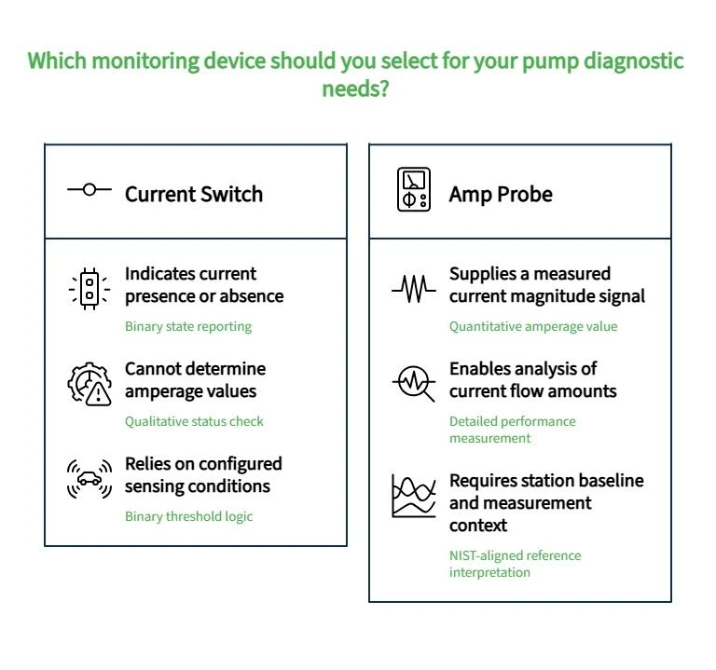
A current switch indicates current presence rather than measured magnitude. A presence record tells you the pump was drawing current. More precisely, it tells you the signal registered current as present or absent at the recorded time, under the device’s configured sensing conditions. It carries no amperage value.
An amp probe supplies a measured current magnitude signal. A magnitude record shows a recorded amount of current, which makes it a different kind of evidence, even when both records appear in the same report.
A magnitude value still needs a reference point: the station baseline, the measurement period, and whatever supporting information is available. The National Institute of Standards and Technology explains measurement uncertainty and the importance of interpreting measurements against appropriate reference information. That general principle supports careful reading of a number. It does not validate any particular pump condition.
The kit descriptions on the OmniSite Kits page illustrate the distinction. The supplied XR50 Plus Kit description includes two pump current switches. The supplied Crystal Ball Plus Kit description includes two pump amp probes. Those descriptions establish what each kit lists. They do not establish what is installed at your station or how accurate any measurement is. That distinction matters most when you review older records, mixed equipment configurations, or documentation tied to a particular model. Product-level detail belongs in documents such as the Amp Probe Data Sheet, checked against your station’s actual equipment.
This raises the first practical question: does your station actually measure magnitude? If the station records presence only, careful reading will not produce an amperage value from that record. A current-switch record answers whether current was present. When the question concerns how much current flowed, look for an amp-probe record.
If an operations supervisor is asked whether a pump “pulled more current than usual” overnight, and the station’s record shows presence states only, the accurate answer is that this record cannot say.
Even a complete magnitude record leaves the most important question open.
Why Neither Pump-Current Signal Confirms a Cause
A current reading does not by itself confirm a mechanical or operational cause. For example, a current-switch record might show a pump running continuously for four hours. A team might assume the pump is severely clogged or failing, when in reality, a float switch is simply stuck in the 'on' position. Presence and magnitude are observations. A cause is an explanation, and an explanation depends on context the record may not contain. Treat this as an evidence-boundary inference drawn from the signal distinction, not as an independently validated diagnostic rule.
The missing context varies by station and by monitoring setup:
Local baseline. Without one, a value can look unusual with no evidence of what the difference means.
Reporting interval and continuity. The interval sets how often observations appear, and continuity determines whether the relevant sequence of records exists at all. An incomplete history can restrict interpretation even when each individual record is clear.
Device and version applicability. A product description identifies what a kit includes, not which sensors or configurations exist at a given station.
Field findings. These can supply context the record cannot.
Treat these as questions to confirm rather than as a checklist every reading must clear. As a general principle, a gap in the monitoring path, such as a missing reporting window, deserves attention on its own terms. It describes what was recorded, not what the pump did.
Alarms are a routine part of station design. Pennsylvania’s operator training material on pumping stations states that an alarm system should be provided at all pumping stations. Because alarms are so common, the habit of treating one as an explanation forms easily. When a visible reading starts getting stretched into a cause, qualify the reading rather than extend its meaning. A record can hold useful current evidence and still lack the evidence type your causal question needs.
Sometimes the obstacle is not the signal but the setting. Imagine being after hours at a lift station: rain taps the enclosure, and wet gloves make it awkward to scroll an incomplete record. Asking for more alerts feels like progress under those conditions. More alerts alone do not fill a gap in context.
Records and field work inform each other. The EPA’s guide for evaluating CMOM programs at sanitary sewer collection systems treats management information systems and collection system operation as separate review areas. That structure reflects a widely accepted practice: neither the record nor the site visit replaces the other.
What Each Pump-Current Record Means
Each type of pump-current record supports one kind of observation and leaves a specific question open. Think of the table as the label under each gauge. It is a framework for reading evidence, not a field assessment.
Signal source | Observation supported | Claim not supported by the signal alone | Question to confirm |
|---|---|---|---|
Current-switch record | Current presence or absence, as represented by the existing record | The amount of current, or why the state occurred | Does this station record presence only, and does the device or version description apply? |
Amp-probe record | Measured current magnitude, as represented by the existing record | Why the magnitude occurred, or a verified fault | What measurement context and station baseline apply? |
Changed current record | A difference in the recorded observation | Why the difference occurred | Are time context, continuity, and field findings sufficient to explain it? |
Incomplete or unclear record | The available record is not enough for a complete interpretation | Normal operation, abnormal operation, or a verified cause | Which signal or contextual fact is missing? |
The table shows the evidence boundary at a glance. It does not judge equipment condition or prescribe corrective action.
What to Confirm Before Explaining a Pump-Current Reading
Before a pump-current reading goes into a log or a shift handoff, confirm what the record shows, what limits it, and what remains open. Start on the screen itself. Scan the timestamp column for gaps, and check whether the displayed value is a state or a number.
Then write the result in a form the next shift will read the same way. Use precise terms such as current presence, measured current magnitude, or an observed difference between records.
A precise handoff might look like this:
Observation: The record shows a current-presence state change.
Evidence limit: It does not show amperage magnitude, and it does not establish a mechanical cause.
Open question: The team still needs to confirm the station’s measurement setup and the relevant field context.
The same structure holds when the record carries a number.
Illustrative handoff for a magnitude change:
Observation: The record shows a change in measured pump current during the reviewed period.
Evidence limit: The recorded values establish the change but not why it occurred.
Open question: The station baseline, reporting continuity, and supporting field evidence still need confirmation.
Bottom line: a note that claims less but holds up serves the crew better than a confident guess. If your evidence supports only an observation, write the observation, and leave any missing element as an acknowledged limitation rather than an assumed fact. If field work later supports an explanation, add it then, with its source.
Pump Current Evidence You Can Hand Off with Confidence
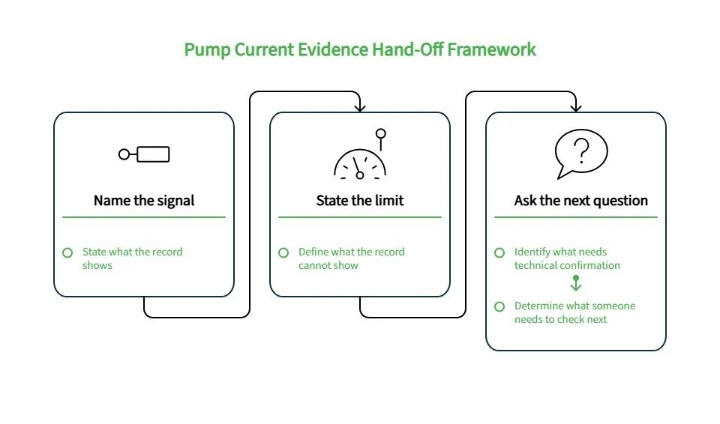
Picture the operations desk again. The phone still buzzes. This time, the supervisor answers with a statement that holds: what the record shows, what it cannot show, and what someone needs to check next.
That is the shift from a reading you could not explain to evidence you can stand behind. Careful handling of operational evidence is part of the professional accountability that public utility work demands, because the communities served by every station depend on decisions made from records like this one.
The Maintenance Interpretation Framework is one practical piece of the larger Pump Monitoring Evidence Framework. Share your qualified observation with colleagues, and identify what needs technical confirmation before anyone settles on a cause.
Name the signal. State the limit. Ask the next question.
Disclaimer: This guide is intended as a comprehensive starting point. Monitoring records and measurement interpretations vary with equipment configuration and operating context, so station-specific technical conclusions require evaluation of the applicable evidence by qualified personnel. For decisions specific to your unique situation, we always recommend consulting a qualified professional.
Our Editorial Process
Our expert team uses AI tools to help organize and structure our initial drafts. Every piece is then extensively rewritten, fact-checked, and enriched with first-hand insights and experiences by expert humans on our Insights Team to ensure accuracy and clarity.
About the OmniSite Insights Team
The OmniSite Insights Team is our dedicated engine for synthesizing complex topics into clear, helpful guides. While our content is thoroughly reviewed for clarity and accuracy, it is for informational purposes and should not replace professional advice.