
📌 Key Takeaways
Define troubleshooting questions first, then require records with clear timing, useful detail, reliable access, and accountable owners.
Define Needs Before Tools: Start with the questions operators ask, then require the exact records needed to reconstruct and compare incidents.
Make Time Meaning Clear: Confirm what every timestamp marks, plus its time zone, precision, and clock alignment before trusting event order.
Keep Useful Detail: Set retention around review and comparison needs; long summaries cannot replace detailed records for finding recurring patterns.
Plan for Data Gaps: Confirm local buffering, delayed data labels, exports, user access, and record retrieval after provider changes.
Treat Sequence as Evidence: Event order supports investigation, but it cannot prove cause without complete records, context, and expert review.
Good history answers questions; long history may not.
Utility operators and project leaders will use the guidance below to define records, timing, retention, access, and ownership.
~ ~ ~ ~ ~ ~ ~ ~ ~ ~ ~ ~ ~ ~ ~ ~ ~ ~
When a lift station alarm fires, the notification itself rarely tells the operations team what happened, in what order, or whether the issue has occurred before. Answering those questions depends on what was recorded, how its timing can be interpreted, and whether comparable records from earlier periods remain accessible. The difference between receiving an alert and reconstructing an incident is the gap between available history and usable history. Closing that gap requires specifying which event details matter, what timing information must be interpretable, how far back comparable context needs to extend, and who is responsible for preserving and retrieving it. Duration alone is not the answer. A year of vague summaries may answer fewer questions than a month of detailed, well-structured records.
Operators can identify what they need to investigate. Project managers can translate that need into requirements. Utility leaders can approve scope. Technical and records specialists can validate the details that depend on system behavior or policy. Defining those needs before evaluating monitoring products gives the utility a clearer basis for making that decision on its own terms.
Start with the Troubleshooting Question and the Records It Needs
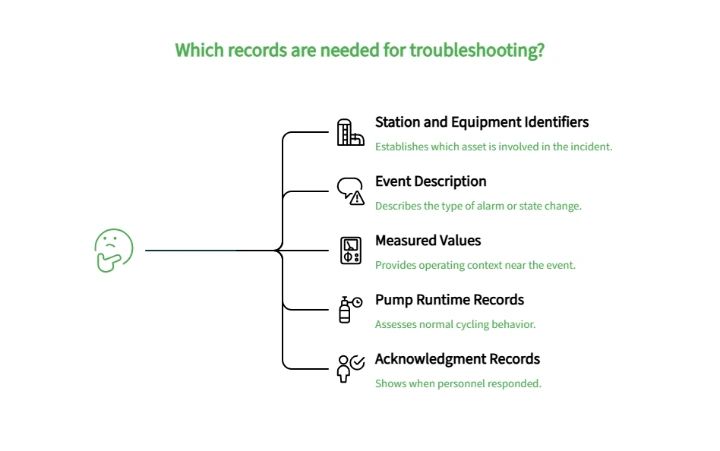
A notification confirms that something triggered an alarm. It does not supply the operating and event context needed to assess what happened or whether it has happened before. The first step toward useful records is listing the questions the operations team asks after an incident and identifying which recorded information would need to exist to answer them.
Consider the categories that support incident reconstruction. Station and equipment identifiers establish which asset is involved. An event description, including the type of alarm or state change, establishes what the system registered. Measured values such as wet well level or pump current near the time of an event provide operating context that separates a nuisance alarm from a developing problem. Pump runtime records help assess whether equipment behavior was consistent with normal cycling. Acknowledgment records show when personnel responded.
Each of these is a candidate field. Whether a system captures it depends on how responsibilities are divided between two functional layers: the local controller at the station and any recurring monitoring service that receives, stores, and presents data remotely. A controller may record state changes and measurements locally, while a monitoring service may log and archive those records in a cloud-hosted historian (a centralized database that stores time-stamped operational data for later retrieval). How an installation divides capture, storage, and retrieval between those layers varies by configuration and service plan.
The practical step is to map each needed record to its actual source. Some information may reside in controller memory, some in a cloud historian, and some in a maintenance management system or operator log. Assuming one source holds everything risks discovering the gap during the investigation. The same discipline applies when controller functions and recurring monitoring services are both involved. A utility can define what information it expects to retrieve from each part of the arrangement, then confirm those expectations against the applicable documentation and service scope.
Different stakeholders contribute different parts of this work. Operators can describe the records they actually use when reconstructing an event. Project managers can turn those descriptions into clear requirements. Utility leaders can decide which requirements belong in project scope. Technical specialists can confirm whether the system captures what the requirements assume, while records specialists can validate any applicable preservation obligations. Distributing the work this way keeps the requirements grounded in real operational practice rather than assumptions about a particular platform.
Make Timestamps Interpretable Before Reconstructing the Sequence
Recorded events are useful only when you can sequence their timestamps reliably. A timestamp that cannot be interpreted is not evidence of when something happened. Timestamp resolution (the smallest time increment a system records, such as seconds or minutes) determines how precisely events can be ordered.
Consider a hypothetical scenario" is robotic throat-clearing. In professional technical writing, it is smoother and more authoritative to transition directly into the example. One reads "High Level Alarm, 03 June 2025, 02:14:00 AM CT." Another reads "Pump 1 State Change, 03 June 2025, 02:14:22 AM CT." A third reads "Operator Acknowledgment, 03 June 2025, 02:17:45 AM CT." The records do not indicate whether each time represents when the event occurred at the station, when the monitoring system received the report, or when the entry was logged in the historian. If one record uses the controller's local clock and another uses a server receipt time, the apparent sequence may not reflect actual event order. For example, if a controller logs a state change at 1-second resolution but the historian only polls data at 5-minute intervals, rapid-cycling pump events may vanish entirely from the cloud record.
Before relying on event order, the team should confirm several points. What does each timestamp represent: occurrence, transmission, receipt, or acknowledgment? What time zone convention applies, and is it consistent across all record sources? What resolution does each source provide? If the controller's clock and the historian's clock are synchronized differently, what is the expected variance?
These are questions to bring to the system documentation and the technical team responsible for the monitoring configuration. Specific behavior depends on the controller model, firmware, historian platform, and service arrangement in use. Treating these details as questions to verify prevents misreading the sequence during an investigation.
Define Retention by the Investigation and Comparison It Must Support
Retention serves a purpose: giving the team enough comparable history to assess whether an incident is isolated or part of a recurring pattern. Defining that purpose before selecting a duration prevents two common problems: keeping too little history to recognize a trend, and assuming that a longer retention window automatically provides better answers.
The review window is the period immediately surrounding an incident, the records needed to reconstruct what happened on that occasion. Comparable historical context is the older information needed to determine whether similar conditions, alarm patterns, or equipment behavior appeared before. These serve different functions, and each may require different levels of detail.
Older records do not always retain the same granularity as recent ones. A trend summary showing daily averages may confirm that elevated wet well levels occurred in a previous month, but it may not reveal whether a specific alarm pattern preceded each rise. If the troubleshooting question requires comparing event sequences across incidents months apart, the retained detail must support that comparison. If older records have been aggregated, summarized, or partially archived, their usefulness for sequence-level comparison may be limited. This distinction separates mere data storage from actionable intelligence. A large volume of older information can still be inadequate if it cannot answer the investigation question at the level of detail required.
Reporting frequency is a separate concept from event capture and retention. A report that appears at a particular interval does not, by itself, establish how individual events are recorded, how long the underlying information is preserved, or whether enough detail remains for later troubleshooting. Similarly, visible history should not be treated as proof of archival preservation. The fact that records appear in a current interface does not confirm that they will remain accessible, at the same level of detail, over the retention period the utility actually requires.
Retention duration is not a universal specification. The period a utility needs depends on the recurrence patterns it must detect, the seasonal or operational cycles relevant to its infrastructure, and any applicable records obligations. Formal retention requirements, where they exist, are established by the utility's records authority, applicable regulations, or institutional policy. They are not determined by a monitoring platform's default visibility window or reporting interval.
Keeping these purposes separate prevents one requirement from being mistaken for another. Operations can define the history needed to investigate and compare events, while technical and records stakeholders confirm whether system capabilities and formal preservation requirements support that need.
Clarify Access, Communication Gaps, and Ownership
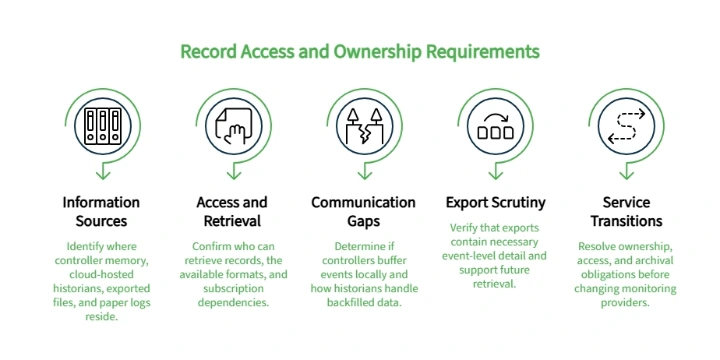
Records that exist but cannot be retrieved when needed do not support troubleshooting. Access, communication reliability, and ownership of records after a service change are requirements to define explicitly.
Start with where each category of needed information resides. Controller memory, a cloud-hosted historian, exported files, and paper logs may each hold different pieces of the picture. For each source, confirm who can retrieve records, what format they are available in, and whether retrieval depends on an active service subscription or platform account.
Cloud access should not be treated as proof of permanent preservation. Access, retention, retrieval, and service obligations are separate questions. A utility should confirm what information remains available, for how long, in what form, and under which service conditions rather than assuming that continued access means permanent storage.
Communication gaps between a station controller and a remote historian introduce a specific uncertainty. If a controller loses connectivity, the events that occur during the gap may or may not be transmitted once communication resumes. Whether the controller buffers those events locally, whether delayed records are marked as late arrivals, and whether the historian distinguishes between real-time and backfilled data are implementation questions that vary by system. Do not assume that a gap in the historian means nothing happened at the station, or that restored communication automatically produces a complete record of the missing period.
Exports require similar scrutiny. Identify who can retrieve them, what information they contain, and whether they preserve the timing and operating context needed for the intended investigation. A summary report that omits event-level detail may not answer the same questions as the original records. Confirm that the format supports later retrieval and fits the applicable records policy before treating an export as the retained record.
Service changes can affect later retrieval as well. If a utility transitions between monitoring providers, what happens to records stored on the previous platform? Can they be exported in a usable format before the transition? Who retains access, and for how long? Do not assume continued access, automatic archival, specific deletion behavior, or automatic data transfer without confirming what the applicable service terms actually provide. These questions are best addressed before a transition, not during one. Questions about ownership or control of records should be resolved from the governing documentation rather than inferred from access alone.
Turn the Questions into a Short Requirements Matrix
Use this matrix as a discussion aid, not a certified checklist or specification.
Troubleshooting Question | Candidate Record or Context | Question to Confirm | Responsible Source or Person |
|---|---|---|---|
What was the event sequence? | Alarm events, state changes, measured values near event time | Does each timestamp represent occurrence, receipt, or acknowledgment? What resolution and time zone? | Controller documentation; monitoring service support; system integrator |
What were the operating conditions? | Pump runtime, wet well level, current readings | Are values recorded at event time or at reporting intervals? | Historian or monitoring platform; controller memory; maintenance records |
Has this pattern occurred before? | Historical alarm records, trend data with sequence-level detail | How far back do records retain enough detail? Has older data been aggregated? | Monitoring service retention terms; archive policy; records authority |
What is missing from a communication gap? | Controller connectivity status, buffered or delayed entries | Are delayed records distinguishable from real-time? | Controller and historian documentation; monitoring service support |
Can records be retrieved after a service change? | Exported reports, archived files outside the platform | What format and timing context do exports preserve? | Service agreement; records policy; IT or records management |
A blank answer in any cell is useful because it exposes an unresolved requirement. The next step is to identify the evidence or stakeholder needed to resolve it, not to fill the gap with an assumption.
Frequently Asked Questions
Can exported reports serve as the utility's retained troubleshooting record?
They may contribute, but assess whether the export preserves the needed event fields, timestamp context, and historical depth. Confirm that the format supports later retrieval and fits the applicable records policy. A summary report that omits event-level detail may not answer the same questions as the original records. Qualified professionals must determine if specific exports are adequate.
Can event history establish why a lift station alarm occurred?
History provides information for investigation, not automatic diagnosis. A record showing that one event followed another does not prove that the first caused the second. Conclusions depend on complete records, interpretable timestamps, operating context, and qualified assessment. Treat sequence as one input to analysis, not as proof of cause.
The value of event history depends on how clearly your utility defines what it needs before an incident demands it. Use the matrix above to identify the records, timing questions, and responsible parties relevant to your stations, then confirm those answers with the stakeholders who can verify what your systems actually capture and who can retrieve it.
For a closer look at how cloud-based monitoring platforms handle historical data and reporting, learn more about OmniSite's GuardDog.
Disclaimer: This article is for general informational purposes only and does not constitute compliance, safety, technical, or professional advice. Requirements, risks, and best practices may vary by context, jurisdiction, system, provider, or use case. Confirm important decisions with the appropriate qualified professional, authority, or technical expert.
Our Editorial Process:
Content is developed from OmniSite source materials and reviewed for clarity, usefulness, and factual consistency. It is intended to help municipal and utility professionals evaluate monitoring and response-readiness options and should not replace site-specific engineering, electrical, regulatory, or safety guidance.
By the OmniSite Insights Team
The OmniSite Insights Team turns field-tested monitoring, alarm-notification, and municipal infrastructure knowledge into practical guides for wastewater, water, and remote equipment teams. OmniSite manufactures control systems that support early warning for lift stations, water systems, wastewater systems, and airfield lighting applications.