
📌 Key Takeaways
Useful lift station alarms pair each condition with site-specific priority, clear context, named response owners, and confirmed service boundaries.
Make Priority Site-Specific: Judge each alarm by its operational consequences at that station, then document the basis and approver.
Send Useful Event Context: Include station identity, event time, current status, supporting readings, and clearly marked missing or stale data.
Separate Workflow Responsibilities: Distinguish notification, acknowledgment, decision ownership, escalation, and resolution so no team mistakes awareness for action.
Confirm Every Service Boundary: Verify what controllers, monitoring services, and people each handle, especially outages, escalation, and staffed response.
Keep One Shared Record: Use a single matrix for decisions, approvals, open questions, and named owners before finalizing tools or services.
Clear context and ownership turn alerts into action.
Utility operators, engineers, and project managers will clarify alarm decisions using the planning framework that follows below.
~ ~ ~ ~ ~ ~ ~ ~ ~ ~ ~ ~ ~ ~ ~ ~ ~ ~
A lift station alarm that reports only a condition name leaves the recipient with an incomplete picture. The notification identifies what changed, but not why it matters at this station, who owns the response, what information supports interpretation, or what happens if the first recipient is unavailable. When a system generates numerous notifications that do not clearly communicate relative urgency or responsibility, the problem compounds — recipients may lack a basis for distinguishing one alert from another. A useful set of alarm requirements connects each of those decisions in one record so that operations, engineering, and a monitoring provider share the same expectations before the system goes live. This article provides a planning framework for specifying priorities, recipients, event context, and escalation ownership. "Requirements" here means documented project expectations, not a nationally prescribed regulatory checklist.
Define Priority by Operational Significance and Context
A priority label requires station-specific documentation to carry operational meaning. A complete alarm-name list is therefore not necessarily a complete alarm requirement — the list identifies conditions, but it may not explain how operations should distinguish them or who approved those distinctions. Two questions shape the decision: what does this condition represent in the station's operating context, and what is the expected operational response category?
Consider a hypothetical example. A municipal project team reviews a proposed high-level wet well alarm. The label says "high priority," but the team has not yet agreed on what station identity, event time, available pump and power information, recipient ownership, or escalation expectation should accompany the notification. Without those answers, the priority label describes urgency in the abstract rather than a planned course of action.
The same issue arises when every alert is given identical treatment. Instead of assigning the same priority to all conditions, the project team must justify and document proposed differences. The answer remains project-specific.
The planning questions worth documenting for each alarm condition include:
What physical or operational state does the condition represent?
What operational purpose does notifying someone about it serve?
What station or wet well context could affect how the condition is interpreted (pump configuration, wet well geometry, downstream capacity)?
What information might influence the proposed priority?
Who reviews and approves the project's priority decision?
A high-level alarm at a station with redundant pumps and significant wet well volume may carry different implications than the same label at a station with a single pump and limited storage. The priority is not a property of the alarm name; it is a judgment about the condition's operational consequences at a specific site.
Operations can help describe practical information needs. Engineers can translate approved needs into project requirements, while project managers can coordinate scope, ownership, and unresolved decisions. This is a working model for discussion, not a universal staffing structure.
Treating priority as a fixed category that applies the same way across every station is a common planning gap. Each assignment should reference the engineering basis, the person or role that approved it, and the operating context that justifies the label. Priority decisions belong to the project's qualified reviewers, not to a generic table. This article does not assign priorities or response deadlines for any real station.
Specify the Information That Makes an Alert Interpretable
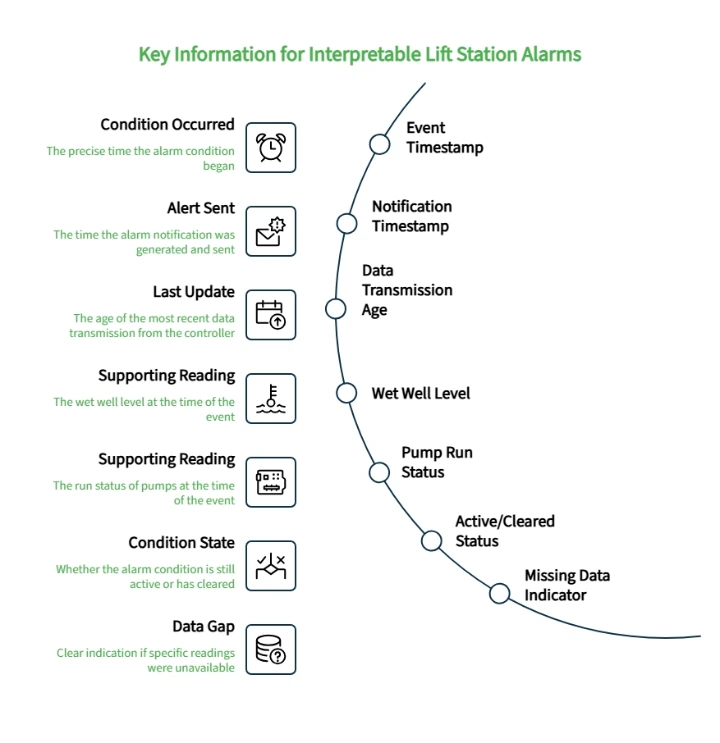
An alarm notification that names the condition and priority still may not give the recipient enough context to interpret the event. The project team should define an information bundle that accompanies each alert, then document which fields the controller or monitoring service can actually provide.
Useful fields to consider: station identity and asset description, a clear condition statement (not only a code or abbreviation), the event timestamp with an identified time zone, the active or cleared status, relevant supporting readings (such as wet well level or pump run status at the time of the event), and the age of the most recent data transmission.
Active or cleared status deserves specific attention. The record should ask whether operations need to know if the reported condition is still active or has cleared. That question should not be interpreted as a claim that every controller or monitoring platform provides that information — it is a planning question to confirm with the vendor. For instance, a high-level alarm that clears before the operator acknowledges it may require a routine site check rather than an emergency dispatch.
Time also needs precision. Event time identifies when the reported condition occurred. Notification time identifies when a notification was generated, sent, or otherwise presented according to the applicable system or service. A requirements discussion should not assume those timestamps are interchangeable. Where event time matters, the record should identify its time zone.
Distinguishing known from missing information is critical. If a reading was unavailable at the time of the event, the notification should make that gap visible rather than leave the recipient guessing whether the field was omitted or the value was normal. Requirements should specify what the team expects to see and how missing data appears.
In the earlier high-level alarm example, the project team must determine whether the notification will indicate which pumps were running, the triggering wet well level, and how recently the controller reported. If pump run status was unavailable, the team needs to know the field is missing rather than assume the pumps were idle. These are planning questions to resolve with the controller vendor and monitoring provider, not assumptions to leave undocumented.
Retention and trend visibility enter the discussion as supporting questions. Rather than assuming that more retained data is automatically more useful, ask what history or trend visibility is needed and why. For example, identifying chronic inflow/infiltration (I&I) issues often requires at least 12 months of retained pump run-time data, whereas simple alarm troubleshooting may only require 30 days. The project can also ask how long relevant information must remain available, but this framework does not prescribe a retention period or service entitlement. Periodic summary reporting and event-driven notification serve different purposes; requirements should distinguish the two so the team does not confuse a daily report with a real-time alert record.
Make Acknowledgment and Escalation Ownership Explicit
Notification, acknowledgment, responsibility assignment, escalation, and resolution are different workflow concepts. If the requirements blur them together, stakeholders may believe an ownership question has been answered when it has not. A useful requirements framework separates four questions:
Was the notification sent or presented?
Was it acknowledged by the designated recipient?
Was responsibility for the next operational decision assigned or accepted?
Was the underlying condition later resolved or otherwise addressed under the project's approved procedures?
While their exact definitions vary, documenting these states separately prevents stakeholders from assuming one action guarantees another.
Initial receipt and acknowledgment. The project should specify who receives the first notification and what acknowledgment means in this context. Acknowledgment confirms that a person is aware of the alarm. It does not confirm that a truck is dispatched, that the condition is diagnosed, or that the problem is resolved. If the project team treats acknowledgment as something more than awareness, that expanded definition needs its own documentation and responsible owner. The project should also document who maintains the callout list or recipient roster as duty assignments change.
Assignment and responsibility. After acknowledgment, who is responsible for evaluating the condition and deciding on the next action? This may be the same person or a different role depending on the condition, time of day, and available staffing. The requirements record should identify the responsible party for each priority category and clarify when responsibility transfers.
Escalation trigger and alternate owner. The project team should define what happens when the initial recipient does not acknowledge within an agreed window, or when the acknowledged condition persists beyond an expected duration. Escalation is a planning decision: who is the alternate, how is the roster maintained, and what authority does the alternate carry? No universal delay or response deadline should be inserted simply to complete the record.
Coverage assumptions deserve explicit attention. After-hours notifications, weekends, holidays, and periods when the primary recipient is on leave need a documented plan. Staffing constraints and competing responsibilities may limit who is realistically available during off-hours. The callout list is a starting point, not a complete escalation strategy. If the roster is outdated or incomplete, the escalation path fails regardless of how well the controller performs.
Alarm-response documentation connects these decisions to ongoing operational use. The requirements record can preserve who owns the initial notification expectation, who owns the escalation decision, and who approves changes to those expectations. That documentation helps keep later stakeholder discussions connected to the original project decisions without prescribing a station-specific emergency procedure.
Assuming a monitoring provider's notification service includes staffed emergency response is another gap to address early. A recurring monitoring or notification service does not, by itself, establish staffed response, automatic dispatch, operational responsibility, or guaranteed action. The requirements record should make the boundary between notification delivery and human response responsibility explicit. The project team should be able to look at the record and identify any unanswered ownership question. An unanswered question is not a gap in the technology; it is a gap in the project's planning.
Separate Controller Expectations from Monitoring-Service Scope
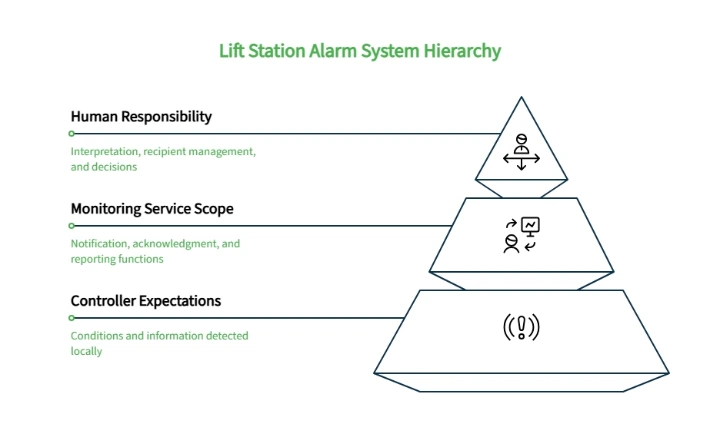
A lift station alarm system typically involves three functional layers: what the controller does locally, what the notification and data service provides remotely, and what remains the responsibility of people. Requirements should distinguish these boundaries so the project team knows where each responsibility begins and ends.
For the station or controller, ask what conditions and supporting information the device is expected to detect and report. For the monitoring provider, confirm what notification, acknowledgment, history, reporting, coverage, and outage-related functions are actually included. For operations, identify who interprets the information, maintains recipient assignments, and owns subsequent decisions.
Service coverage should be treated as an explicit scope question, not as an assumed capability. The same applies to outages. Teams should ask how the service documentation addresses unavailable or stale information, service coverage, notification responsibilities, and any limitations during an outage. Do not assert how a device behaves during a failure without applicable documentation from the manufacturer or provider. The requirements should not invent device or communications behavior where that behavior has not been established.
Teams must also confirm whether the "monitoring service" includes staffed human response or only the specific functions described by the provider.
As one example, OmniSite's supplied GuardDog alarm notifications and historical reporting page describes alarm receipt and acknowledgment, customizable email, text, and call recipients, historical data, and reporting. The supplied How It Works page describes logging state changes that trigger alarms and sending alerts to a designated callout list. Those descriptions illustrate capabilities a monitoring service may document; they do not establish current plan entitlements, retention commitments, notification latency, guaranteed response, or availability. The How It Works description does not establish complete event capture, automatic operational resolution, guaranteed availability or delivery, or a specific escalation sequence. Confirm the scope of any service against its current applicable documentation before relying on it in a requirements record.
The project team should ask what happens during a communications outage, how missing or delayed data is identified, and whether the service scope aligns with the escalation plan.
Bring the Requirements Together in One Record
The planning questions from the preceding sections fit into a single alarm-requirements matrix. Each row represents a group of related decisions. Unresolved fields remain open project questions with an identified owner responsible for closing them.
Requirement Field | Question or Decision to Document |
|---|---|
Condition and operational purpose | What physical or operational state does this alarm represent, and what is the intended purpose of notifying operations about it? |
Priority rationale and decision owner | What priority category applies, what is the engineering basis, who reviews and approves the priority decision, and why is the proposed treatment appropriate for this project? |
Event information, timestamp/data age, and relevant history | What identity, condition description, active or cleared status, event time and time zone, supporting readings, data age, retention need, or trend history is required for interpretation? |
Initial recipient, acknowledgment expectation, and responsibility owner | Who receives the notification first, what is acknowledgment intended to mean, and who owns responsibility for the response decision after acknowledgment? |
Escalation condition, alternate owner, and coverage/outage assumptions | What condition triggers a handoff, who is the alternate owner, how is the roster maintained, and what staffing, service coverage, unavailable-information, or outage assumptions require confirmation? |
Controller/service boundary, approval reference, and review trigger | Which expectations belong to the controller, the monitoring service, or people? What project reference approves the decision, and what change should trigger another review? |
The hypothetical high-level alarm from earlier sections would occupy one row. The team enters the condition, priority rationale, expected event information, initial recipient and acknowledgment expectation, escalation trigger and alternate, and controller-versus-service boundary. Each field gets the documented decision or a named owner responsible for resolving it. A field left blank without an owner is an unmanaged assumption.
For example, a high-level wet well alarm row might look like this:
Condition: Wet well level exceeds 15 ft (measured by a submersible level transducer).
Priority rationale: High – indicates potential overflow within 30 mins; approved by Ops Lead.
Event information: Station ID, wet well level reading, active status, and pump 1 & 2 run status.
Initial recipient: On-duty operator contacted via GuardDog™ (acknowledgment means receipt confirmed, not resolved).
Escalation: Unacknowledged after 10 mins escalates to Ops Manager following the configured Callout List.
Boundary: OmniSite controller detects level; GuardDog sends SMS; Ops Manager owns dispatch.
Each unresolved field should identify a decision owner. The approval reference can preserve where the final decision was authorized, while the review trigger can identify when a changed project assumption requires reconsideration. That structure also helps keep the record connected to the people who use it. Operations can identify practical interpretation needs, engineering can address those needs within the project specification, and project management can track ownership and approval.
This matrix is a planning tool for project discussion. It is not a compliance checklist, a deployment-ready specification, or a substitute for qualified engineering review.
Questions to Resolve Before Finalizing the Requirements
How should unresolved alarm requirements be recorded?
Record the unresolved question, the name of the person or role responsible for the decision, and the relevant approval reference in the requirements matrix. An unanswered field is not an approved setting. Keeping it visible in the record prevents the team from treating an assumption as a documented expectation.
Plan the Requirements Before Selecting the Tools
Clear lift station alarm requirements depend on more than selecting alarm names. Each condition also needs a documented priority rationale, useful event context, and defined ownership for acknowledgment and escalation. Keeping those decisions in one record makes unresolved assumptions visible before controller or monitoring-service requirements are finalized.
Priority rationale, event context, recipient ownership, escalation expectations, and a clear controller-to-service boundary turn a notification into information the right person can act on. The matrix gives the project team a shared record for resolving those decisions. Use it to prepare questions for the utility's operations lead, project engineer, and monitoring provider before finalizing project requirements.
Disclaimer: This article is for general informational purposes only and does not constitute compliance, safety, technical, or professional advice. Requirements, risks, and best practices may vary by context, jurisdiction, system, provider, or use case. Confirm important decisions with the appropriate qualified professional, authority, or technical expert.
Our Editorial Process:
Content is developed from OmniSite source materials and reviewed for clarity, usefulness, and factual consistency. It is intended to help municipal and utility professionals evaluate monitoring and response-readiness options and should not replace site-specific engineering, electrical, regulatory, or safety guidance.
By the OmniSite Insights Team
The OmniSite Insights Team turns field-tested monitoring, alarm-notification, and municipal infrastructure knowledge into practical guides for wastewater, water, and remote equipment teams. OmniSite manufactures control systems that support early warning for lift stations, water systems, wastewater systems, and airfield lighting applications.