
📌 Key Takeaways
Overflow prevention works best when every alarm has a tested path to the right person.
Test Every Alarm: An alarm only helps when it reaches someone who can respond fast.
Own The Callout List: A current callout list prevents old contacts from becoming hidden failure points.
Watch System Health: Power loss, weak signal, and low battery can blind a station before trouble starts.
Use History Wisely: Alarm records show what happened, who responded, and where patterns keep repeating.
Start With One Station: One high-risk site can prove the plan before teams expand it.
Prevention is not one device; it is a tested path from warning to action.
Municipal wastewater teams will gain a clearer way to reduce overflow risk, guiding them into the lift-station planning details that follow.
~ ~ ~ ~ ~ ~ ~ ~ ~ ~ ~ ~ ~ ~ ~ ~ ~ ~
A high-water alarm rarely fails because of one obvious mistake. More often, it fails quietly: a callout list that nobody updated after a staff change, a phone-line connection that degraded over the winter, a sensor that worked fine the day it was installed and was never tested again. By the time anyone notices, the question is no longer "what went wrong with the pump?" It is "why didn't anyone find out sooner?"
That second question is the real subject of lift station overflow prevention. The pump, the float switch, the controller — these are pieces of equipment that fail in fairly predictable ways. What determines whether a failure turns into an overflow is whether the surrounding system catches the failure early enough for someone to respond: whether the alarm reaches a person, whether that person is the right one, and whether the response is documented well enough to learn from. For municipal teams, that kind of early warning is not just operational housekeeping. Sanitary sewer overflows can contaminate waterways, degrade water quality, back up into homes, and threaten public health, according to the EPA — which is exactly why keeping wastewater where it belongs matters as much as it does.
This guide treats overflow prevention as a planning discipline rather than a single purchase. It walks through what the term actually covers, why purely reactive monitoring tends to break down, and what a workable plan looks like for a utility that does not have the staff or budget to redesign every station at once.
What Is Lift Station Overflow Prevention?
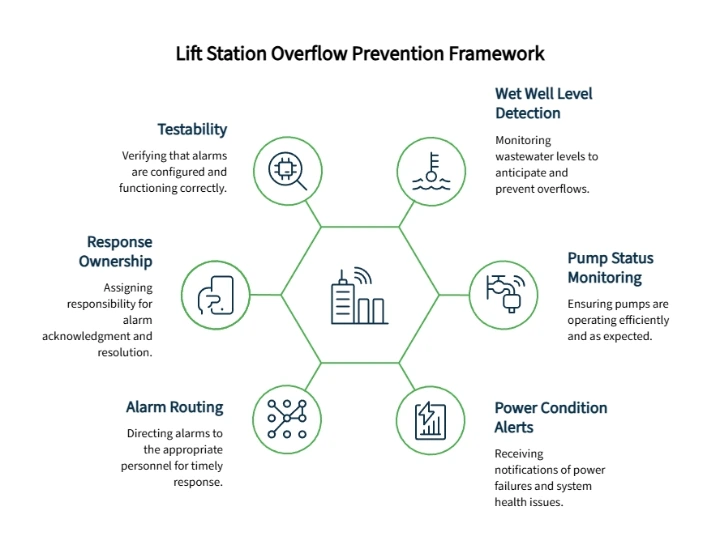
Lift station overflow prevention is the practice of making wastewater levels, pump status, power conditions, alarm routing, and response ownership visible before a high-water event becomes a sanitary sewer overflow. It is built from five interlocking parts: detecting rising wet well levels, knowing whether pumps are running as expected, receiving power-failure and system-health alerts, routing those alarms to the right person, and reviewing the resulting history so the same failure does not repeat.
A sixth element ties the rest together: testability. A plan that lists the right alarms on paper is not the same as a plan that has confirmed those alarms are configured, routed to a live contact, acknowledged when they fire, and reviewed afterward. The gap at most stations is usually not the absence of an alarm; it is the absence of a verified, tested path from that alarm to a person who can act on it.
A stronger monitoring and response plan reduces blind spots and shortens the time between a failure and a response. It does not guarantee that an overflow, an equipment loss, or a regulatory issue will never occur. Sewer systems vary widely in age, design, and condition, and no single planning framework eliminates every variable.
Why Reactive Lift Station Monitoring Fails
A purely reactive approach depends on everything going right at the exact moment something goes wrong. That is a fragile assumption, and it tends to break down in a handful of recurring ways.
A high-water alarm exists, but the person it reaches is no longer with the utility, or the callout list was never updated after a shift change. Power fails at the station, but the communication path that would normally carry that signal fails along with it, so the outage goes unreported until a field check reveals it. A cellular monitoring device was installed at some point but never formally activated, so it sits at the station without transmitting anything. Signal strength at the site was never verified, so the unit appears to work until the moment it is actually needed. A maintenance key left in the disabled position quietly suppresses notifications. None of these failures are dramatic on their own. Stacked together across dozens of stations and years of staff turnover, they are exactly the kind of single points of failure that turn a routine pump issue into an unmonitored overflow.
The U.S. Environmental Protection Agency lists inadequate pump maintenance and a lack of backup power among the recurring causes of sanitary sewer overflows, alongside aging infrastructure and excess inflow. The agency's own training materials on collection system and lift station maintenance reinforce a related point: standard operating procedures, routine lift station inspection, generator readiness, and bypass pumping all remain part of the foundation. Monitoring supports that foundation rather than replacing it — a remote alarm tells the team something needs attention, but it does not inspect the wet well or service the generator on its own.
This pattern matches what shows up at the field level: it is rarely one catastrophic failure. It is usually a chain of smaller gaps — in equipment, in communication, or in process — that nobody noticed until the water was already rising. This is also why aging infrastructure and severe weather are such a difficult combination for reactive systems: a station that has run reliably for years can still go blind during the one storm that knocks out power across a service area, simply because nobody verified the backup communication path under stress.
The Core Components of a Lift Station Overflow Prevention Plan
A practical plan is built from a set of components that work together. Some utilities already have several of these in place; the goal is less about starting from zero and more about identifying which pieces are missing, untested, or owned by no one in particular.
High-Water Alarm Visibility
The high-water alarm is the first non-negotiable element of any plan. It is worth asking a few direct questions about it: which sensor or float actually triggers it, whether that signal reaches a remote system or only sounds locally at the station, who is notified when it fires, whether the notification path has been tested recently, and whether the resulting alarm history is stored anywhere a supervisor can review it later. A lift station alarm that only sounds at the station itself provides little protection for a problem that happens at 2 a.m. on a weekend.
Pump Runtime and Cycle Awareness
Pump runtime, cycle counts, and flow trends are not a predictive maintenance silver bullet, but they are a useful early-warning signal. A pump cycling unusually often, or running far longer than its typical pattern, is often showing a problem before it becomes an outright failure.
Power Failure Notification
A plan needs a clear answer to a simple question: will the team know when the station loses utility power? That answer depends on whether the monitoring path itself can still report during an outage, how power-related alarms are routed, and whether the alarm delay is tuned correctly. Too short a delay creates nuisance alerts that staff start to ignore; too long a delay can hide a real problem until it has already escalated.
Backup Battery and Signal-Health Awareness
Monitoring hardware is only useful if the hardware itself is healthy. A complete plan includes visibility into weak cellular signal, battery status, and communication-check failures, since a device that has quietly lost connectivity provides exactly the same false sense of security as no monitoring at all.
Callout List Ownership
A callout list is operational infrastructure, not a document that gets written once and filed away. It needs a clear owner, a defined review schedule, and answers to a few practical questions: who receives the first alarm, what happens if that person does not acknowledge it, and whether text, email, and voice notifications are being used in a way that actually fits how the team works. GuardDog supports customizable callout lists with email, text, and voice notification options as part of OmniSite's monitoring software.
Alarm Acknowledgment and Event History
A record of what happened, who was notified, and who responded is what turns a single incident into useful organizational knowledge. Event history confirms whether an alarm was actually sent, shows whether someone acknowledged it, helps identify stations with recurring issues, and supports a clear after-action review when something does go wrong.
Backup Control or Redundant Monitoring
Redundancy, in plain terms, means a single failed component should not leave the team blind. For some stations that means backup visibility alone; for others it means backup pump control as well. For a station where the existing alarm system has become difficult to maintain, redundancy can also mean adding an entirely independent alarm path rather than continuing to patch the original one. A lift station controller with relay outputs can provide both monitoring and limited backup pump control, depending on the configuration and the station's needs.
Field-Friendly Setup
A plan that only a specialized programmer can maintain tends to fail in practice, because that person eventually leaves or is unavailable on a weekend when a callout list needs an urgent edit. A workable plan should be maintainable by the same field team that uses it day to day, without requiring custom factory configuration for routine changes.
Activation and Cellular Readiness
This is one of the most commonly overlooked planning steps. Cellular monitoring devices need to be activated before they can transmit alarms or data — a unit that is installed but never activated will not protect the station, however well it is wired. Cellular signal strength should be verified at the installation site, and antenna placement matters, since coaxial cable run alongside high-voltage wiring or alarm horn power can degrade performance.
GuardDog Setup Discipline
Configuring monitoring software correctly is its own planning step: creating a callout list of who is notified and in what order, building a callout plan for which list applies on which day and shift, and configuring general alarms — primary power, battery status, signal strength, and communication check. Testing the configuration after any change is what confirms the plan actually works.
Training and Support Readiness
Implementation anxiety is often less about the technology and more about staff confidence. Product training covering wiring, installation, activation, and the monitoring web interface can reduce that anxiety, particularly for utilities concerned about staff turnover. In-person training is offered free of charge, alongside a GuardDog-focused webinar option, though participants generally cover their own travel costs. Certain advanced features — including some GuardDog 2.0 capabilities — are tied to specific OmniAdvantage plan benefits rather than included universally.
A 10-Point Lift Station Overflow Prevention Planning Checklist
Use this checklist as a starting point to assess where the current setup stands, station by station.
Identify the highest-risk lift stations. Which stations would create the largest environmental, operational, or public-trust problem if they overflowed?
Confirm high-water alarm visibility. Does the alarm reach the team remotely, or does it only sound locally at the station?
Verify the alarm path. Who receives the alert, through which method, and in what order?
Audit the callout list. Is it current, tested, and owned by a specific person or role?
Check power-failure notification. Will the team know if the station loses AC power?
Check backup battery and signal-health monitoring. Can the team see weak signal, low battery, or communication issues before they become a blind spot?
Review pump runtime and cycle data. Are runtime, cycles, and flow trends reviewed often enough to catch abnormal patterns?
Confirm alarm acknowledgment and history. Can the team see who was contacted, who responded, and when?
Document the response plan. What should happen during high water, power loss, pump failure, or a communication outage?
Start with one station and expand. Select one high-risk site, verify the plan end to end, and use it as the model for the next group of stations.
Immediately after completing this checklist, a quick field verification pass helps confirm the plan will actually hold up under real conditions:
Activate the device before relying on it for transmission.
Measure cellular signal strength at the installation location.
Route antenna wiring away from high-voltage cables or alarm horn power.
Verify installation of all required current switches, probes, or level transmitters.
Configure primary power, battery status, and communication-check settings.
Ensure no maintenance key or disabled status will suppress notifications.
Validate that callout lists account for after-hours, weekend, and shift coverage.
Direct staff to product documentation and training support.
Where Cellular Monitoring Fits in Overflow Prevention
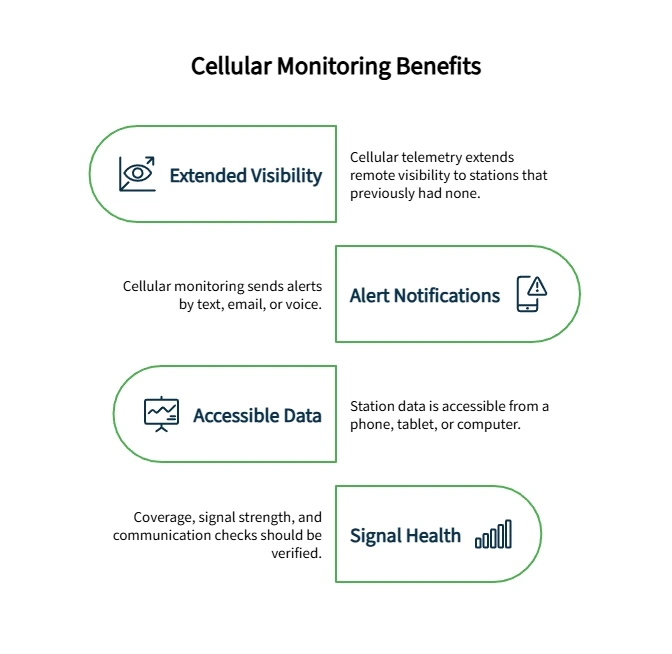
Cellular telemetry is one practical way to support a prevention plan, particularly for stations that currently rely on hardwired telephone lines, radio repeaters, or manual site checks. It can extend remote visibility to stations that previously had none, send alerts by text, email, or voice, and make station data accessible from a phone, tablet, or computer rather than requiring a physical visit to confirm status.
OmniSite's wastewater monitoring product line includes devices like Crystal Ball, built as a cloud based wastewater monitoring system for lift station monitoring and backup pump control, alongside the XR50 for remote equipment monitoring and alarm notification. GuardDog functions as the notification and reporting layer across these devices, supporting callout lists, alarm acknowledgment, map view, and historical data export. The point here is not to compare every available option, but to understand the category of technology that supports the components described above.
As with any cellular-based system, coverage, signal strength, antenna placement, activation status, and communication checks should all be verified as part of the prevention plan rather than assumed. Cellular reception can vary by site conditions, carrier coverage, and environmental factors, and that variability is exactly why signal-health monitoring is one of the components worth planning for rather than skipping.
How to Start Without Overhauling Every Station
A prevention plan does not have to begin with a full system replacement. It can begin with one station, one verified alarm path, and one documented response plan — then expand once that pattern is proven.
A workable starting sequence looks like this: pick one high-risk lift station, confirm the high-water alarm input is reaching the right place, confirm power-failure notification is working, build or update the callout list for that station, test the full notification path end to end, and review the first set of alarm and runtime history before deciding what comes next. Along the way, it is worth confirming cellular signal and antenna placement, confirming activation is complete, and confirming the callout plan accounts for different shifts and after-hours coverage. Once that single station is verified, the process repeats at the next site, using the first station as the template.
In short, the sequence runs: station audit, then alarm path test, then callout update, then trend review, then rollout to the next station.
Field teams that inherit a mix of legacy wiring, unclear labeling, and an outdated callout list are not dealing with a personal failure — they are dealing with a planning gap that accumulated over years of staff turnover. The fix is the same either way: pick a station, verify the path, and document what is found.
Common Planning Mistakes to Avoid
A few mistakes show up often enough to call out directly:
Treating a local alarm light as a complete prevention strategy, when it only helps someone who happens to be standing at the station.
Assuming an old callout list is still accurate without testing it.
Skipping alarm acknowledgment testing, so a notification path looks fine until the moment it actually matters.
Ignoring power-failure and signal-strength alerts because they seem secondary to the high-water alarm itself.
Waiting for a pump failure before reviewing runtime patterns that may have already shown a problem developing.
Designing a setup that only a specialist programmer can maintain, which tends to fail the first time that person is unavailable.
Upgrading hardware without assigning clear response ownership for what happens after an alarm fires.
Routing antenna coaxial cable alongside high-voltage cables or alarm horn power wires, which can degrade signal quality.
Skipping wiring steps needed for the runtime, flow, or alarm-history reports the utility expects to see later.
When to Consider a Monitoring Upgrade
A few signs tend to suggest it is time to revisit the current setup: stations are checked manually because remote visibility is incomplete, alarms still depend on aging telephone lines or radio paths, operators cannot easily pull up alarm history, callout lists are difficult to edit or verify, pump runtime data goes unreviewed, and power or signal issues are not consistently reported. If the team is also looking for engineering specifications, datasheets, or other documentation ahead of a bid project, that is generally a sign the evaluation phase has already begun.
Frequently Asked Questions
What should a lift station overflow prevention plan include?
At minimum, it should cover high-water alarm visibility, pump runtime awareness, power-failure alerts, backup battery and signal-health monitoring, an owned and tested callout list, alarm acknowledgment and history, and a documented response plan for each failure scenario.
How do high-water alarms help prevent overflows?
They alert the team when wet well levels rise past a defined threshold, giving operators time to respond before wastewater reaches the point of overflow. Their usefulness depends entirely on whether the alarm reaches a person who can act on it.
Can cellular monitoring support existing wastewater infrastructure?
In many cases, yes — cellular monitoring can add remote visibility or backup monitoring without an immediate full overhaul. The right fit depends on the station's existing controls and wiring, which is worth evaluating station by station.
Does a monitoring system guarantee that an overflow will never happen?
No. No monitoring system, alarm setup, or response plan can guarantee that every overflow, equipment loss, or communication failure will be avoided. A well-built plan reduces blind spots, shortens response time, and creates a clearer record of what happened — the kind of ongoing operational discipline described in the EPA's CMOM resources for collection systems.
Building a Plan That Holds Up
Lift station overflow prevention is not about predicting every possible failure. It is about removing the avoidable blind spots: the alarm that never reached anyone, the callout list nobody tested, the cellular device that was installed but never activated. When a utility knows which stations carry the most risk, which alarms matter most, who receives them, and how the response gets documented, overflow prevention stops being a stressful unknown and becomes a repeatable operating process.
That process does not require replacing every legacy system at once, and it does not require a dedicated programmer on staff. It requires picking one station, verifying the path from sensor to person, and building outward from there. No plan removes every variable from an aging collection system, but a tested plan gives operators earlier warning and a better chance to respond before a high-water event becomes a much larger problem.
Have questions about building a practical lift station overflow prevention plan for a specific collection system? Contact Us to talk through the current monitoring setup. For utilities already evaluating equipment, Get a Quick Quote connects directly with a local representative, or Find Your Representative for installation and local support questions.
Disclaimer: This article is for general educational purposes only and does not replace site-specific engineering, electrical, operational, or regulatory guidance. Wastewater collection systems vary by design, age, control architecture, local requirements, and risk profile. Municipal teams should evaluate their own equipment, site conditions, safety procedures, and applicable regulations before making monitoring or control changes. No monitoring device, alarm-notification system, service plan, or response workflow can guarantee prevention of every overflow, equipment loss, communication failure, regulatory issue, or property damage. OmniSite's offerings should be understood as monitoring and notification services, not insurance. Cellular monitoring depends on activation, available service, installation conditions, antenna placement, signal strength, and ongoing maintenance of monitored equipment.
Our Editorial Process:
OmniSite content is developed to help municipal water and wastewater professionals make practical, informed decisions about remote monitoring, alarm notification, and infrastructure visibility. Articles are based on OmniSite product documentation, website materials, field-informed operating concepts, and general wastewater management principles.
By the OmniSite Insights Team
OmniSite manufactures monitoring and control systems that help protect people and the planet by giving municipal teams early warning of equipment failures at lift stations, pump stations, water systems, and other critical infrastructure. OmniSite's solutions support remote visibility, alarm notification, reporting, and practical system management for public works and utility teams.