
📌 Key Takeaways
A changed pump runtime shows longer or shorter operation, but teams need site context and field checks to explain why.
Runtime Alone Cannot Explain Causes: Teams need normal operating patterns, incoming wastewater levels, and field findings to explain a runtime change.
Sensor Types Shape Evidence: Current switches show whether current is present, while amp probes measure how much current flows.
More Reports Add Detail: Shorter reporting intervals help teams narrow when a change occurred, but they do not explain its cause.
Missing Reports Leave Questions: Gaps may reflect communication problems, so teams cannot assume the pump stopped when reports disappeared.
Separate Findings From Questions: Teams can keep conclusions grounded by stating what changed, what limits interpretation, and what still needs confirmation.
Runtime shows a change; context helps explain it.
Maintenance managers and pump station supervisors will learn how to interpret runtime changes through the evidence framework below.
~ ~ ~ ~ ~ ~ ~ ~ ~ ~ ~ ~ ~ ~ ~ ~ ~ ~
A Runtime Change Is an Observation, Not an Explanation
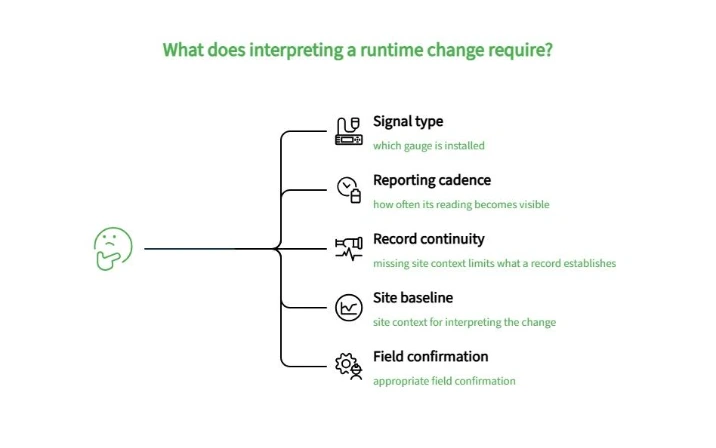
A pump runtime change shows that a pump operated longer or shorter within the visible monitoring record. It does not explain why. Explaining the change requires signal type, reporting cadence, record continuity, site baseline, and appropriate field confirmation. Runtime data alone supplies none of these.
The phone buzzes at the operations desk of a municipal lift station early in the morning. An overnight review surfaces a runtime value longer than the previous window. The instinct is understandable: a longer runtime must mean something specific happened. That instinct is the problem.
Treating a changed runtime as though it identifies its own cause is the most common source of unclear record context in pump station maintenance. The reading is real, but the explanation is not yet in the record. Signal type, reporting cadence, and missing site context each limit what a monitoring record can establish. Those limits do not disappear because the number on screen is unambiguous.
Consider a monitoring record the way a crew considers an instrument panel. A gauge confirms that something changed, but interpreting it depends on which gauge is installed and how often its reading becomes visible. A station running two different sensor types produces two different evidence streams from the same event. The record does not interpret itself.
The Pump Monitoring Evidence Framework is a conceptual structure for interpreting pump-monitoring evidence, its limits, and the questions that still require confirmation. Think of it as a shared legend for maintenance records. It helps teams describe what is seen, name the boundary of that evidence, and surface the next question without claiming diagnostic certainty. It does not diagnose. It disciplines the interpretation.
What Context Does a Runtime Record Need?
A runtime record needs five categories of context before it can support any explanation. A changed reading confirms that something changed. The familiar maintenance challenge that follows is pressure to explain the reading before adequate context is available. The Pump Monitoring Evidence Framework turns that pressure into three questions, asked in sequence. What does this record show? What context limits interpretation? What remains unconfirmed?
These five categories determine how far a record can support any interpretation.
Signal type. The monitoring kit installed at the station determines what the record can measure. A pump operating state, a current-presence indication, a measured amperage value, and a wet well level reading are four distinct types of information. A Current Switch confirms that current was present, but it does not show how much current was flowing. A 4-20mA Amp Probe supplies measured magnitude. These are different evidence types. Treating them interchangeably produces a cause inference the record itself cannot validate.
Reporting cadence. The visible reporting interval determines how much detail appears in any given window. A longer interval can conceal short-duration events that a shorter interval would capture. Cadence shapes what is visible in the record, not what caused the runtime to change.
Record continuity and timestamp meaning. A gap in the monitoring record is not evidence of a gap in pump operation. Missing intervals, interrupted data paths, and undefined timestamp semantics each change what the record can establish. An event occurrence time, a message receipt time, and an acknowledgment time describe three different moments, and reading one as another distorts the sequence. Understanding event history and data retention requirements for lift station troubleshooting helps teams read continuity accurately. Historical display shows what was reported, not what sampling occurred behind it. The GuardDog page notes data visibility of up to six months.
Site baseline and inflow context. A runtime duration that reads as elevated at one station may fall within normal range at another. Historical operating patterns, inflow conditions, wet well levels, and pump duty arrangements together form the comparison a runtime change needs. An increase in incoming wastewater volume, for example, could plausibly account for longer pump operation. Without corresponding site evidence, though, increased inflow remains a possible explanation rather than an established cause. The available documentation identifies no universal runtime threshold or site baseline that marks when a change indicates a mechanical problem.
Field confirmation. When the record establishes an observation but not a cause, it is more useful to name what field work would resolve the remaining question than to stretch the record’s meaning beyond what it can support. When the available signals cannot distinguish between possible explanations, the responsible conclusion is that the cause remains unconfirmed.
One boundary deserves its own sentence: a feature-utilization score describes how a monitoring platform’s reporting capabilities are being used, not pump condition. Treating a utilization check as an equipment-health finding is another form of the same interpretive error.
How Signal Type Changes What the Record Can Show
The kit installed at a station determines what type of evidence the record contains. Two configurations show a meaningful distinction:
The Crystal Ball Plus Kit includes two pump amp probes and a submersible level transducer, which supply measured current magnitude and level data.
The XR50 Plus Kit includes two pump current switches, which confirm current presence but do not supply measured magnitude.
Both configurations serve documented monitoring purposes. The distinction matters for interpretation, not for ranking.
Measured magnitude adds context without adding a diagnosis. A 4-20mA Amp Probe supports measurement of motor current through an analog signal. That measurement can enrich a runtime observation, but it does not by itself identify a mechanical fault. Even when amperage data is available, its meaning still depends on operating conditions, equipment characteristics, and whether the measurement is relevant to the question being asked.
For example, if a pump station operations supervisor reviews the morning record and finds a current-present state for Pump 1 active throughout the visible window, that reading confirms the pump ran. That confirms the pump ran. It does not confirm:
what current magnitude was reached
whether that magnitude was within an expected operating range
what caused the runtime to extend
The installed signal type did not measure magnitude. Drawing a cause from current presence alone treats a presence signal as a measured value, which it is not. Additional sensor data would expand what the record can observe, but it would still not establish the cause on its own.
Teams should also confirm sensor availability and reporting capabilities against the applicable equipment configuration and version before drawing operational conclusions from any record.
How Reporting Cadence Limits Visible Detail
Reporting cadence determines how much detail is visible, not why a runtime changed. The OmniSite GuardDog documentation describes two reporting intervals:
a report every 24 hours under the standard service plan
15-minute reporting on analog values under the Elite service plan
These are documented visible reporting intervals. They are not evidence of continuous analog sampling, uninterrupted communication, guaranteed alarm-delivery timing, or a causal threshold for any runtime duration.
This insight changes how teams should approach an unexplained runtime change: more visible data is not automatically more diagnostic context. A 15-minute interval produces 96 data points per day rather than one. That density helps narrow the window in which a change occurred. It does not supply the site baseline, measured magnitude, or field confirmation needed to explain why the change occurred.
Monitoring-path warnings describe system reporting health rather than a confirmed mechanical pump fault. Examples include weak cellular signal alerts and device failure-to-report notices. A gap caused by a communication issue is a different finding from a gap caused by pump behavior, and the record alone may not distinguish between the two. OmniSite’s wastewater monitoring information frames the same separation: the condition of the monitoring system is not the condition of the equipment being monitored. Before interpreting an apparent gap in pump activity, determine whether it reflects an observed equipment state or simply unavailable monitoring information.
The Runtime Observation-versus-Explanation Reference
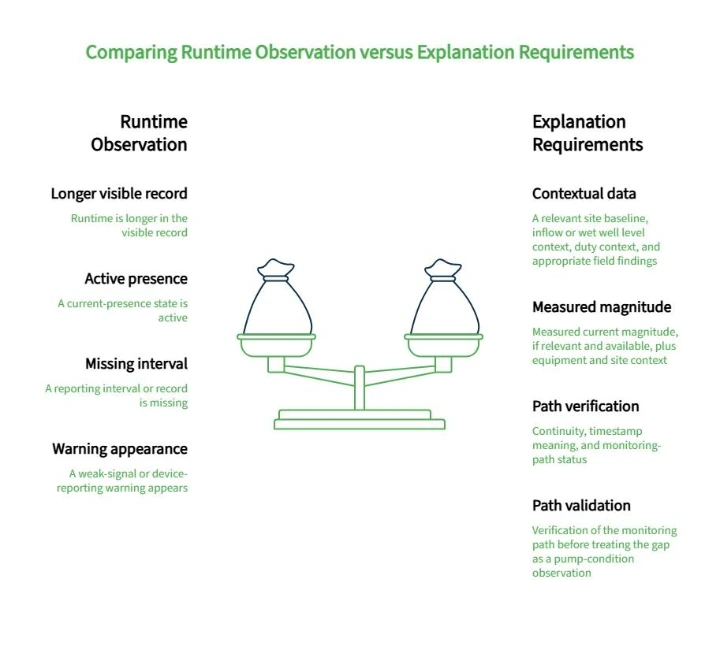
What the record shows | What is still needed before explaining it |
|---|---|
Runtime is longer in the visible record | A relevant site baseline, inflow or wet well level context, duty context, and appropriate field findings |
A current-presence state is active | Measured current magnitude, if relevant and available, plus equipment and site context |
A reporting interval or record is missing | Continuity, timestamp meaning, and monitoring-path status |
A weak-signal or device-reporting warning appears | Verification of the monitoring path before treating the gap as a pump-condition observation |
This reference is not a fault-detection procedure. It works as a shared legend that helps maintenance managers, operations supervisors, and collection system managers apply the same meaning to the same observations.
Observation is not confirmation of cause.
How to State What Is Known, Limited, and Unconfirmed
Teams state a runtime finding responsibly by separating three elements: the observation, its evidence limit, and the remaining question. OmniSite’s approach to Pump Monitoring Systems diagnostic frameworks for maintenance teams centers on shared interpretation limits and visible remaining questions, not premature conclusions. The Pump Monitoring Evidence Framework gives that goal a practical structure. Maintenance managers, pump station operations supervisors, and collection system managers can use the three-part pattern together without overstating what any record supports.
Observation. State what changed in the visible record. “Runtime for Pump 2 is longer in today’s record compared to the previous reporting window.”
Evidence limit. State which signal, interval, baseline, continuity, or timestamp constraint narrows the interpretation. “The kit at this station includes current switches, not amp probes, so current magnitude is not available in this record.”
Remaining question. State what requires technical or field confirmation. “A site baseline under comparable inflow conditions is not available for this station. That comparison would help determine whether this duration falls outside normal range.”
In a standard team review, each role contributes a different piece:
The maintenance manager states the observation and the evidence limit.
The pump station operations supervisor notes whether field conditions that day account for part of the change.
The collection system manager identifies what inflow or level data would provide useful context.
No role claims a cause the record cannot supply. That discipline also keeps monitoring alerts from acquiring meanings they do not support. When records are incomplete, acknowledging the limitation serves the team better than selecting an explanation too early.
The framework’s practical value lies in making uncertainty specific. Instead of reporting that a pump behaved abnormally, the team can name what changed, which comparison was used, and which evidence is still unavailable. A vague concern becomes a defined question someone can go answer.
The framework is a conceptual aid, not a packaged diagnostic method. It does not replace field verification or professional judgment when those are required. For example, if Pump 1 shows a 4-hour continuous runtime (observation), but the site uses XR50 current switches (evidence limit), the unconfirmed variable is whether the pump was actually moving fluid or simply spinning dry. A field check of the wet well level and check valve status is required before scheduling a pump replacement. The available documentation supplies no universal baseline or causal threshold for a runtime change.
Back at the operations desk, the phone that buzzed this morning still shows a longer runtime. What changed is the conversation around it. The question is no longer “what caused this?” but “what does this record show, what limits our interpretation, and what do we still need to find out?” The goal is not to remove uncertainty from every report. It is to ensure that each conclusion the team reaches remains supported by the evidence it actually has. That shift, from unsupported cause inference to disciplined observation, is the core value of this framework: it begins with stating both what the record shows and what it cannot establish.
Disclaimer: The OmniSite Insights Team is our dedicated engine for synthesizing complex topics into clear, helpful guides. While our content is thoroughly reviewed for clarity and accuracy, it is for informational purposes and should not replace professional advice. This guide is intended as a comprehensive starting point. For decisions specific to your unique situation, we always recommend consulting a qualified professional.
Our Editorial Process:
Our expert team uses AI tools to help organize and structure our initial drafts. Every piece is then extensively rewritten, fact-checked, and enriched with first-hand insights and experiences by expert humans on our Insights Team to ensure accuracy and clarity.
By: OmniSite Insights Team
The OmniSite Insights Team is our dedicated engine for synthesizing complex topics into clear, helpful guides. While our content is thoroughly reviewed for clarity and accuracy, it is for informational purposes and should not replace professional advice.