
📌 Key Takeaways
A fail-safe wet well strategy removes blind spots by adding backup monitoring, not by trusting one device to catch every failure.
- Audit Silent Failures First: Walk each station asking what can fail without anyone knowing — before buying any new equipment.
- Back Up the Brain: A second controller that works on its own keeps the station visible even when the main system goes down.
- Test the Alert Chain: Alarms that reach only one person's phone on vacation night are the same as no alarms at all.
- Track Trends, Not Just Emergencies: Pump runtime and cycle data can reveal growing problems well before a high-water crisis hits.
- Treat Monitoring as Ongoing: Stale phone numbers, unchecked batteries, and unreviewed settings quietly turn good hardware into false confidence.
One failure shouldn't leave an entire station blind — redundancy closes that gap.
Municipal wastewater operators and collection system managers will gain a clear three-step framework for strengthening station reliability, preparing them for the detailed overview that follows.
~ ~ ~ ~ ~ ~ ~ ~ ~ ~ ~ ~ ~ ~ ~ ~ ~ ~
A Near-Miss Overflow Is a Warning, Not a One-Time Event
Thursday night. Rain heavy since noon.
The wet well at Station 7 is climbing. The primary controller should be cycling the lead pump, but the panel lights look wrong. The on-call operator checks a phone that hasn't buzzed. No text. No call. The hardwired dialer shares a phone line with the office, and nobody is in the office at 11 p.m.
Did the alarm even go out?
That silence — where a notification should be — is the gap most utility teams discover only after a near-miss. It serves as an immediate indicator that the station relies on vulnerable, isolated mechanisms.
A fail-safe wet well monitoring strategy reduces single points of failure across level sensing, pump control, communications, and operator notification. It does not mean equipment can never fail. It means the system is designed so one failure does not leave the entire station blind. The U.S. EPA recognizes sanitary sewer overflows as a significant public health concern — which is exactly why building redundancy into collection system monitoring matters.
Three steps: audit, back up, and verify visibility.
Step 1: Audit the Single Points of Failure at the Station
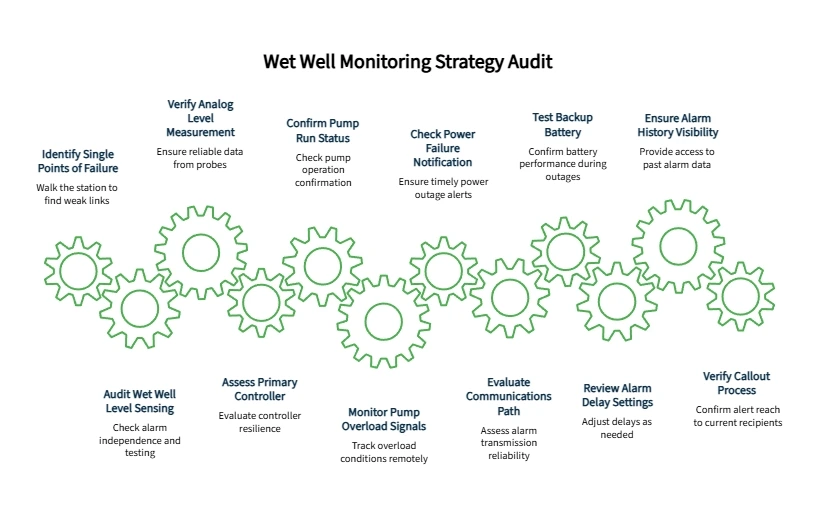
The first step is not buying equipment. It is understanding where the station depends on a single device, wire path, communications method, or person.
Walk the station with one question: What can fail silently?
Walk it like something has already gone wrong. The purpose is not to assign blame. The purpose is to find the weak link before the next high-water event finds it for you.
- Wet well level sensing — Is the high-level alarm independent, visible, and recently tested? Is a low-level signal monitored where applicable?
- Analog level measurement — Is the level probe or transducer providing reliable data to the controller?
- Primary controller — What happens if the main PLC locks up or loses power?
- Pump run status — Can the team confirm which pumps are actually running?
- Pump overload signals — Are overload conditions monitored remotely?
- Power failure notification — Does the station tell someone when AC power drops?
- Communications path — Is the alarm still riding on fragile hardwired telemetry? If that path fails during a storm, the team may never know.
- Backup battery — Can the monitoring device keep reporting during an outage?
- Alarm delay settings — Have delays been reviewed since initial installation?
- Alarm history and trend visibility — Can the team see what happened before the alarm, not just the alarm itself?
- Callout process — Does the alert reach a real callout list, or just one person's phone?
Also verify cellular signal strength and antenna placement at the site, and confirm that callout recipients are current. Tracking pump runtime, cycles, and GPM trends over time reveals developing problems well before a crisis. The Environmental Finance Center Network reinforces these routine reliability practices for lift station alarm management.
The output of this step should be a single page that says: here is what can fail, here is what we can see, and here is the gap. Nothing fancy. A clipboard, a station name, and a set of honest checkmarks can be enough to start.
Monitoring is only useful when it watches the conditions that actually create risk. In a wet well, that means level, pump status, power, communications, and response routing. The exact signals vary by station design, but the audit logic stays the same. The EPA's CMOM guidance frames collection system performance around management, operation, and maintenance practices — good monitoring is part of a managed reliability process, not a one-time accessory.
Step 2: Add Independent Backup Monitoring and Control
Redundancy is not complexity. It is a backup path.
A station can have a primary controller and still be vulnerable if all monitoring, notification, and pump-control logic depends entirely on that one device. The most dangerous assumption in a lift station is that the main controller will always be available to report its own failure. If the main brain fails, the backup path should still know the wet well is rising.
A redundant layer should operate independently of the primary PLC. Look for these capabilities: independent wet well level monitoring, backup pump control with alternation and interstart delay support, alarm notification through a separate communications path, and simple menu-driven configuration that does not require custom PLC programming.
That last point matters. If only one specialist can configure the system, the station has a knowledge dependency that is itself a single point of failure. A backup strategy should be understandable to the operator who opens the panel in the rain. It should not require a specialist-only workflow for every adjustment. It should make the station easier to trust, not harder to maintain.
The OmniSite Crystal Ball backup pump controller is designed around this principle — a cellular pump station monitor with 14 digital inputs, 4 analog inputs, and 4 relay outputs for direct pump control, all configurable through web-based menus without specialized programming. The XR50 cellular pump station monitor is also a practical option for remote equipment supervision and alarm notification at stations where backup pump control is not required.
Adding backup monitoring reduces the risk that one controller or communications failure becomes an undetected high-water event. No system guarantees zero failures, but a properly configured redundant path significantly narrows the window where a failure goes unnoticed. Site conditions, installation quality, cellular reception, device configuration, power conditions, and equipment condition all affect performance — which is why Step 2 should stay practical and testable.
Cybersecurity also belongs in the conversation when remote monitoring or cloud-connected systems are used. The CISA Water and Wastewater Cybersecurity page provides resources because digital disruption can affect community services and connected infrastructure. Use connected monitoring where it improves visibility, but protect access, manage users, and follow current cybersecurity guidance. No connected system is immune to cyber risk.
Step 3: Close the Loop with 24/7 Remote Visibility
Hardware redundancy is incomplete unless the right people are notified quickly and can see what is happening.
Picture this: a utility installs a backup controller and wires every input correctly, but the alert still goes to one supervisor's personal cell phone. That supervisor is on vacation. The wet well rises for three hours before anyone responds. The monitoring strategy is not finished until the notification layer is tested and real.
A practical visibility check should answer four questions:
- Who gets the first alert?
- Who gets the second alert if the first person does not respond?
- Which alarms are critical enough for immediate escalation?
- How often are contacts and alarm histories reviewed?
That layer also needs clear alarm triggers, email/text/voice call alerts through multiple channels, a callout list with several contacts at the right priority levels, alarm history and trend reports, map or dashboard visibility, and mobile or web access for field checks. Test the entire alert-to-response chain regularly.
OmniSite's GuardDog cloud platform supports these needs. Alerts are dispatched to a designated callout list with notifications customizable by text, email, and phone call for up to 15 individuals. The standard service plan provides a report every 24 hours; the elite plan provides 15-minute reporting on analog values. GuardDog stores historical data for a specified retention period—ranging from six months up to five years, depending on your device and service tier. The XR50 cellular pump station monitor records pump runtimes, GPMs, pump cycles, and digital alarm inputs, then delivers that data through GuardDog's web interface and mobile app.
This does not require a massive IT project. Modern cellular monitoring platforms work as a practical operating layer that existing staff can manage. That said, cellular monitoring depends on coverage, installation quality, antenna placement, and environmental conditions — verify signal strength and backup power at the site before relying on any alert path.
Remote visibility is also not a substitute for maintenance. Monitoring helps the team see and respond. It does not remove the need to maintain pumps, floats, power systems, wiring, and site equipment.
Common Mistakes That Keep a Wet Well Strategy from Being Truly Fail-Safe
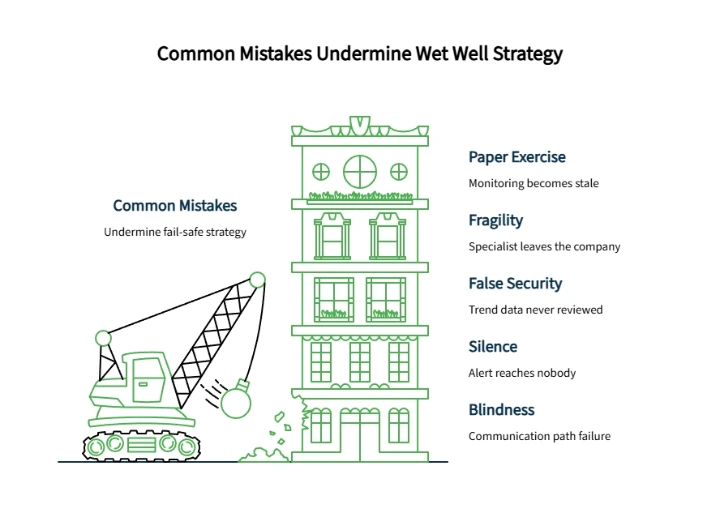
Treating one high-level float as the whole strategy. A single float does not reveal pump status, power loss, or rising trends that precede the emergency.
Depending on one communications path. If it fails during the same event that raises the wet well, the team is blind.
Depending on one person to receive every critical alert. Vacations, shift changes, and missed calls can turn a perfectly wired station into a silent one.
Adding monitoring without testing the callout list. An alert that reaches nobody is not a response plan.
Ignoring cellular signal strength and antenna placement. A weak signal that nobody checked after the enclosure was moved is a gap waiting for the worst possible moment.
Skipping pump runtime and trend data. Runtime and cycle trends help teams catch problems before failure becomes catastrophic. Collecting trend data but never reviewing it creates a false sense of security.
Failing to review alarm delays after installation. Default delay settings may not match the station's actual risk profile or response times.
Choosing a system only one specialist can configure. If that person leaves, the monitoring becomes fragile in a way no hardware can fix.
Treating monitoring as a one-time install instead of an operating process. A stale phone number, a disabled notification, or an unchecked battery turns redundancy into a paper exercise.
The 3-Step Fail-Safe Blueprint
Step | Question to Ask | What to Verify | Output |
1. Audit | What can fail silently? | Level signals, pump status, power, communications, callout routing | A station-specific failure-point checklist |
2. Back Up | What keeps working if the primary controller fails? | Independent monitoring and backup control path | Reduced dependence on one controller or alarm path |
3. Verify Visibility | Who sees the alarm, how, and how fast? | Alerts, recipients, schedules, history, reports | Tested callout plan and remote dashboard access |
A one-page blueprint can make this process easier to repeat. Use it during station reviews, after near-miss events, or before budget planning. Include the station name, current controller, wet well level signals, high-level alarm status, pump runtime status, power failure notification, backup battery condition, communications path, callout list, alarm history, and next action owner.
Share this with the operations team before the next station review.
Build the Strategy Before the Next High-Water Event
That Thursday night scenario — the rising wet well, the silent phone, the amber light nobody sees — does not have to repeat. A fail-safe wet well monitoring strategy starts with a simple audit, adds an independent backup path, and finishes with tested 24/7 visibility. Three steps. No massive SCADA rebuild. No specialist programmer. Just a clear plan to remove blind spots before a minor equipment issue becomes a major operational event.
The goal is practical protection: know sooner, respond faster, reduce preventable overflow risk.
Explore OmniSite wastewater monitoring solutions to see how cellular monitoring, backup pump control, and cloud-based alerting fit into a fail-safe strategy for your collection system. Teams comparing options can start with wastewater monitoring resources, then review the Crystal Ball or XR50 when product-level evaluation becomes useful.
Frequently Asked Questions
What does fail-safe mean in wet well monitoring?
A fail-safe strategy reduces single points of failure across level sensing, pump control, communications, and alerting. It does not mean equipment can never fail — it means one failure is less likely to leave the station unmonitored.
What should a utility audit first?
Start with the wet well level signal, high-level alarm, primary controller, pump runtime inputs, power failure notification, communications path, backup battery, callout list, and alarm history.
Why does independent backup control matter?
A backup controller that operates independently creates a second response path if the primary PLC fails, reducing the risk of an undetected high-water event.
Can a wet well monitoring strategy work without complex SCADA programming?
Yes. Many monitoring strategies can be built around practical alarm notification, cellular telemetry, and cloud visibility. The strategy should prioritize clear alerts and straightforward configuration that existing operations staff can manage.
How do remote alerts support overflow prevention?
Remote alerts notify operators about high wet well levels, pump failures, or power loss quickly enough to respond before a minor condition escalates. Effectiveness depends on a tested callout list, multiple notification methods, and verified cellular coverage.
Is cellular monitoring guaranteed to work at every lift station?
No. Cellular monitoring depends on service availability, reception, antenna placement, installation quality, environmental conditions, and routine testing. Verify signal strength and backup power at the site before relying on any cellular alert path.
Disclaimer: This article is for general educational purposes for municipal wastewater monitoring and planning. It is not an installation manual, engineering specification, electrical wiring guide, or substitute for qualified professional evaluation. Monitoring and notification services depend on proper installation, configuration, maintenance, service availability, and site conditions. Always consult current OmniSite documentation, applicable codes, and qualified personnel before installing, wiring, configuring, or modifying lift station monitoring or control equipment.
Our Editorial Process:
OmniSite content is developed from product documentation, field-use context, and wastewater monitoring subject matter expertise. Technical claims should be checked against current OmniSite documentation before publication.
By OmniSite Insights Team:
The OmniSite Insights Team creates practical resources for municipal wastewater, water, and infrastructure teams evaluating remote monitoring, alarm notification, and cellular telemetry solutions.