
📌 Key Takeaways
A backup pump alone doesn't prevent overflows — every link in the alert chain must work, from sensor to notification.
- Backup Gear Isn't a Backup Plan: A spare pump sitting idle won't help if the sensor, alarm path, or callout list fails first.
- Silent Alarm Paths Cause Real Damage: The biggest risk often isn't the pump — it's the communication path that carries the alarm dying without anyone noticing.
- Expensive Systems Can Still Leave You Blind: Legacy monitoring setups may lock basic data behind outside specialists, hiding slow pump wear until it's too late.
- Scheduled Site Visits Can't Replace Live Alerts: Pump failures and power outages strike during storms and weekends — not during your next inspection round.
- Trace One Alarm Start to Finish: Pick your riskiest station and map every step from high-water sensor to phone notification — the longest gap is where to focus first.
The station that fails silently causes the most damage.
Municipal wastewater operators and utility managers will gain a clear framework for auditing their most exposed stations, preparing them for the detailed monitoring guidance that follows.
~ ~ ~ ~ ~ ~ ~ ~ ~ ~ ~ ~ ~ ~ ~ ~ ~ ~
The Station Looked Covered — Until the Alarm Path Failed
Every light on the panel shows green. The backup pump is wired. The floats are set.
Three miles away, a wet well is rising. The primary pump seized 47 minutes ago, but the alarm never fired — the communication path that carries it failed silently during the last storm. Nobody knows there's a problem until a resident calls about sewage in the street.
This is not a freak event. For municipal wastewater teams managing dozens of stations, it's the predictable result of reactive maintenance — a system that discovers failure only after the damage is underway.
Traditional wastewater redundancy planning fails when it treats backup equipment as enough, while leaving communication paths, alarm routing, pump data visibility, and control logic as single points of failure. Reactive maintenance waits for evidence after the event; proactive planning tests the full failure chain before a wet well overflow, outage, or pump failure exposes the gap.
That distinction matters for Lift Station Overflow Prevention. A backup pump is useful. It is not a backup plan by itself.
The EPA estimates between 23,000 and 75,000 sanitary sewer overflows occur each year in the United States — many beginning with exactly this kind of hidden, silent failure. According to the EPA's sanitary sewer overflow guidance, SSOs can contaminate waterways, create serious water-quality problems, back up into homes, and threaten public health.
What Reactive Maintenance Looks Like in a Lift Station
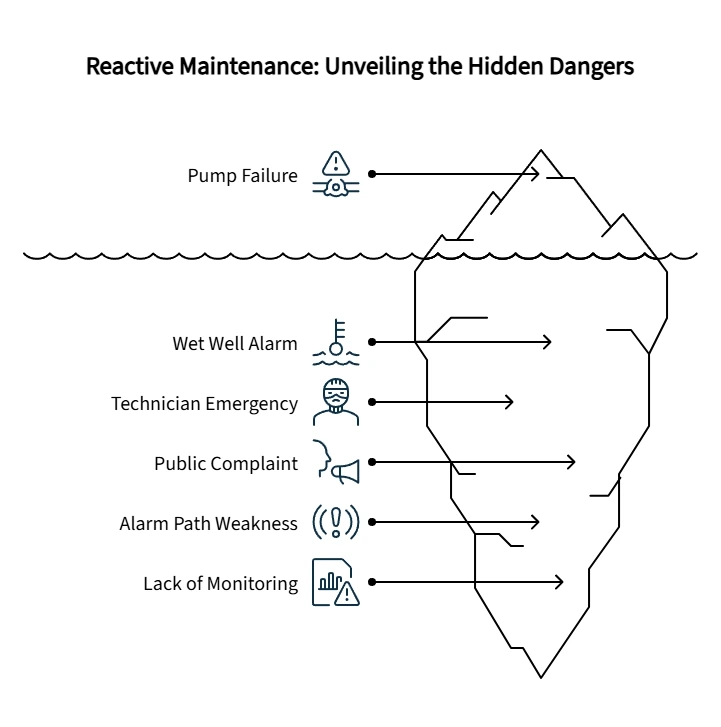
Reactive maintenance means finding out after the fact. After the pump fails. After the wet well rises past the alarm setpoint. After a field technician gets pulled from a scheduled job to handle an emergency, or after a public complaint lands on the utility director's desk.
The danger isn't carelessness. Most operators are pragmatic professionals doing serious work with limited budgets and small crews. The danger is that reactive maintenance feels normal until the one path nobody checked goes silent at the worst possible moment.
The weak point may not be the pump. It may be the alarm path. A field crew can be diligent and still miss the early warning signs if the system does not show pump runtime, pump cycles, high wet well alarms, communication status, or power-loss behavior in time to act. That is why Wastewater Monitoring should be viewed as part of the failure chain, not as a separate convenience.
Myth 1: "If the Station Has Backup Equipment, It's Redundant"
The reality: Equipment redundancy is not system redundancy.
A backup pump doesn't help if the level sensor that triggers it has drifted. A backup float doesn't help if the relay activating the alternation logic has corroded. Consider a collection system manager reviewing station readiness before storm season. The checklist looks complete — backup pump installed, floats calibrated, panel serviced. But nobody has verified whether the alarm transmission path, the callout escalation sequence, or the backup power behavior will actually function under load.
True system redundancy requires the entire chain: wet well level detection, pump status visibility, alarm transmission, callout list escalation, backup power behavior, backup pump control, and operator acknowledgment. Break any single link, and the backup equipment sits idle while the wet well rises.
A practical Lift Station Controller strategy supports more than pump operation. It should help operators understand wet well level, pump status, alarm activity, and backup-control behavior before the station becomes an after-hours scramble.
Ask your team: "If the primary pump, power, or communication path fails tonight, how exactly will the right person know?"
Myth 2: "Legacy SCADA Gives Full Visibility"
The reality: A system can be expensive and still leave operators blind.
Legacy SCADA installations create a dangerous form of false confidence. The system exists, it cost a significant amount, and it has a screen with data. But can operators actually access pump cycles, runtimes, amp draw, alarm history, and communication status without calling in an outside specialist?
Many legacy setups lock basic changes behind proprietary software. A simple pump delay adjustment can mean scheduling a service call. Meanwhile, slow degradation — a pump drawing higher amps over weeks, a float drifting incrementally — goes unnoticed because the data isn't accessible or doesn't reveal the trend.
OmniSite's engineering standards require that system software be fully configurable by the owner using a simple fill-in-the-blank configuration method, reflecting a broader industry shift: monitoring data is generally most valuable if the responsible team can access it, understand it, and act on it without delay.
Better visibility also supports faster prioritization. It helps teams send limited labor where the risk is highest, reduce avoidable emergency response, and protect public confidence — without inventing a full rebuild project.
Ask your team: "Can operators view the pump and alarm data needed to catch degradation — without outside support?"
Myth 3: "Field Checks Can Catch Problems Fast Enough"
The reality: Field checks are valuable, but they can't replace real-time alerting.
Pump failures, power outages, and rising wet wells don't follow a schedule. They happen during storms, overnight, on weekends, and between inspection rounds. The EPA identifies causes of sanitary sewer overflows including line breaks, sewer defects, and power failures — none of which wait for the next site visit. For a station checked once a week, the gap between a problem starting and someone knowing can stretch to days.
For broader regulatory context, the EPA's NPDES program regulates point sources that discharge pollutants to waters of the United States under the Clean Water Act framework. Combined sewer systems are a different category from sanitary sewer systems, but the GAO's Clean Water Act report reinforces the larger wet-weather planning challenge: heavy rainfall can overwhelm systems and cause raw sewage to overflow into waterways.
Ask your team: "How long could this station be in alarm before someone off-site knows?"
The 3 Single Points of Failure to Audit First
Before upgrading anything, map where the system is most exposed:
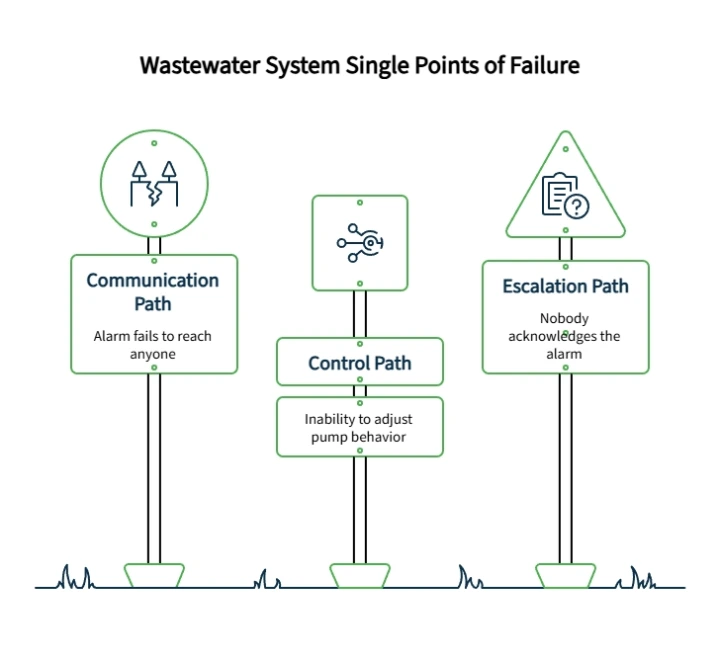
1. The Communication Path. The weak point may not be the pump — it may be the path that carries the alarm. If the station depends on a single communication method and that path fails during a storm, the alarm never reaches anyone. Physical lines, damaged pathways, poor antenna placement, weak signal strength, or outdated routing can all weaken that path. Cellular telemetry helps reduce reliance on fragile single-path notification.
Audit question: Which single path must work for the alarm to leave this station?
2. The Control Path. The weak point may be the primary controller or PLC — specifically, the inability to adjust pump behavior quickly. The OmniSite Crystal Ball includes relay outputs for backup pump control, pump alternation, and interstart time delays, with setpoint adjustments that don't require outside programming.
A Cellular Pump Station Monitor can support earlier visibility into pump and station behavior when it is selected, installed, wired, and configured for the required monitoring points. Reporting on pump cycles, runtime, GPM history, flow history, rainfall history, notification history, or alarm history depends on proper wiring, current switches or sensors, setup, and configuration.
Audit question: What happens if the primary control path is unavailable?
3. The Escalation Path. The weak point may be the callout list itself — who gets notified, in what order, and what happens if nobody acknowledges. The GuardDog Web Interface supports customizable callout lists, email/text/voice alerts, and alarm acknowledgment workflows. The practical value is not just receiving an alarm — it is knowing who saw it, when it happened, and whether the team has a clear next step.
Audit question: When was the callout list last tested under real operating assumptions?
What Proactive Wastewater Redundancy Planning Does Differently
Proactive planning does not start with buying more complexity. It starts with mapping the chain.
A practical wet well monitoring strategy asks: What detects high level? What confirms pump status? What sends the alarm? Who receives it? Who acknowledges it? What happens if power is lost? What happens if the primary control path fails?
The goal is not more screens. The goal is fewer blind spots.
A Practical First Step: Replace the Blind Spot, Not the Whole System
The path forward doesn't require ripping out existing infrastructure. For many municipalities, the most practical step is adding a monitoring layer that closes the most dangerous blind spots.
A Cloud Based Wastewater Monitoring System can help operators see alarms, trends, and station status from outside the fence. The OmniSite XR50 records pump runtimes, estimated GPMs, and pump cycles while sending lift station alarms by email, text, or voice call. The Crystal Ball adds backup pump control, amp draw monitoring, and alarm history — all configurable without outside programming. Full reporting capability depends on proper installation of current switches and sensors.
Cellular monitoring can support earlier detection and reduce reliance on fragile notification paths, but cellular service is not guaranteed to be available, continuous, or uninterrupted in every location or installation. Signal strength, antenna placement, wiring quality, device activation, configuration, and local conditions all matter. Installation and electrical work should follow official product documentation, applicable codes, and qualified personnel guidance.
These tools don't replace regulatory obligations. But they can help reduce dependence on a single fragile path and give teams the kind of visibility that turns vague anxiety into a concrete, auditable plan.
Before the next maintenance meeting, pick one lift station and trace the high wet well alarm from float or sensor to notification. Write down every dependency. The longest silence in that chain is the first place to investigate.
Quick Self-Audit: Is Your Redundancy Plan Actually Reactive?
Walk through these questions with your operations team before the next storm season:
- What has to happen for the right person to receive a high wet well alarm after hours?
- Which part of that chain depends on a single communication path?
- Can operators view pump runtime, cycles, and alarm history without outside support?
- What happens if the primary control path is unavailable?
- Are power loss, signal strength, and battery status actively monitored?
- When was the callout list last tested with a real alarm?
- Which station would create the largest operational, environmental, or public-reputation problem if it failed silently?
If any answer is unclear, the redundancy plan may be more reactive than it appears. Download the 3 Single Points of Failure infographic and bring it to your next station review. For a broader look at how cellular monitoring supports lift station overflow prevention, explore OmniSite's wastewater monitoring solutions or review product literature before your next audit.
Disclaimer: This article is for general educational purposes only and is not legal, engineering, or regulatory advice. Wastewater monitoring, overflow response, and reporting obligations vary by jurisdiction, permit, system design, and operating conditions. Municipal teams should verify requirements with their engineer, legal counsel, state regulator, and applicable NPDES or local permit authority before making operational or compliance decisions.
Our Editorial Process:
This article should be created from OmniSite's approved content strategy, reviewed against OmniSite source documents, checked for technical accuracy by a qualified OmniSite product or operations reviewer, and updated when product specifications, service details, or regulatory references change. Claims involving public health, compliance, product performance, or technical specifications must be supported by approved OmniSite materials or cited authoritative sources.
By OmniSite Editorial Team:
OmniSite manufactures monitoring and control systems for municipal infrastructure, including water and wastewater applications. OmniSite's content is written to help utility leaders and operations teams understand practical ways to improve visibility, reduce blind spots, and protect people and the planet.