
📌 Key Takeaways
Undetected lift station overflows turn small station problems into full operational crises.
Awareness Prevents Crisis: Fast alerts give teams time to respond before a wet well problem becomes an emergency.
Missed Alarms Disrupt Work: Late overflow detection pulls crews from planned maintenance and pushes other work behind schedule.
Old Systems Hide Risk: Aging telemetry can look reliable while broken alert paths leave crews unaware during storms.
Remote Visibility Matters: Cloud and cellular monitoring help teams see alarm history, status, and trends before dispatching.
Near-Misses Teach Gaps: Reviewing every overflow helps leaders find weak alarms, fragile callouts, and risky blind spots.
Silence is not safety when a lift station depends on fragile alerts.
Municipal utility leaders and collection system managers will gain clearer overflow prevention priorities, setting up the detailed overview that follows.
~ ~ ~ ~ ~ ~ ~ ~ ~ ~ ~ ~ ~ ~ ~ ~ ~ ~
The phone rings at 3:00 AM on a Saturday. Rain has been hammering the collection system since midnight. The on-call technician scrambles to get dressed, drives 23 minutes to a lift station, and arrives to find the wet well has been overflowing for at least two hours. Nobody knew. The high-water alarm never reached anyone.
That single gap — the time between when a problem begins and when the right people find out — is what turns a manageable equipment issue into a full operational crisis. And it happens more often than most municipal teams want to admit.
An undetected lift station overflow creates cascading operational impact by delaying response, diverting field crews from scheduled maintenance, increasing documentation and cleanup workload, raising public and regulatory scrutiny, and exposing weaknesses in the utility's monitoring strategy. A lift station overflow is not only a field event. It is a schedule event, a staffing event, a documentation event, and often a public-confidence event.
What Is an Undetected Lift Station Overflow?
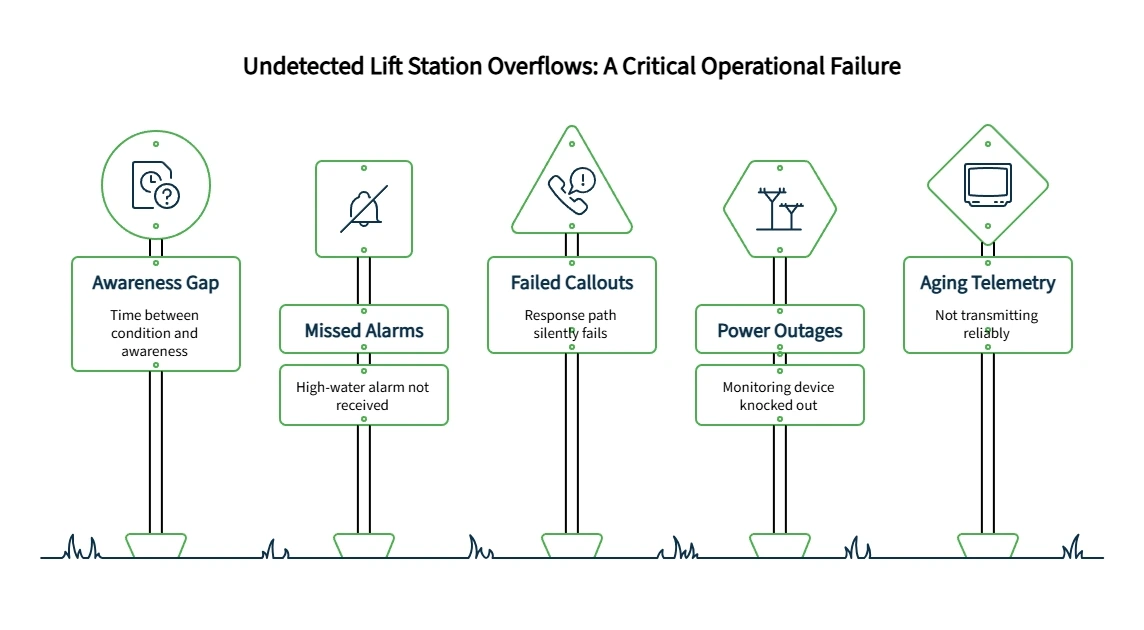
A lift station overflow occurs when sewage rises above the wet well's containment capacity and escapes into the surrounding environment. What makes an overflow undetected is the time gap — the window between when the condition begins and when the operations team becomes aware of it.
The word "undetected" matters. It does not always mean nobody had equipment in place. It means the awareness chain failed somewhere between the condition at the station and the person responsible for response. That gap can stem from a missed high-water alarm, a callout path that failed silently, a power outage that knocked out the monitoring device, or an aging telemetry system that appeared to be working but was not transmitting reliably. In each case, the station seemed monitored. The team had no reason to respond. And the overflow continued.
That gap is where operational control is lost.
Awareness time is the variable that determines how serious the consequences become. A condition identified within minutes is a maintenance call. The same condition identified two hours later — or not at all until a neighbor reports it — is an operational emergency with a much longer recovery.
The Immediate Operational Shock: Emergency Response Replaces Scheduled Maintenance
When a lift station overflow goes undetected, scheduled maintenance becomes emergency response.
This shift is deceptively costly. On the surface, it looks like one bad morning. In practice, it reorganizes the entire day — and sometimes the entire week.
When an overflow is discovered late, the operations team immediately begins triaging. Supervisors redirect crews from whatever they were doing. Trucks that were heading to a valve inspection or a pump replacement turn around. Phone calls go out to utilities, environmental contacts, and sometimes local officials. The emergency takes priority, as it should, but nothing about that process is free.
The clipboard on the passenger seat changes. So does the priority list.
The planned work doesn't disappear. It moves to the back of the queue. Preventive maintenance that was scheduled for Tuesday gets pushed to whenever the team can return to it, which may be days later depending on staffing. Internal coordination pressure builds as supervisors manage the immediate response while also trying to salvage what remains of the week's schedule. That pressure is real, and it compounds with each additional emergency.
The Cascading Impact on Municipal Infrastructure Teams
The immediate disruption is only the beginning. Once a late-detected overflow sets the crisis in motion, its effects spread across every layer of the operations team.
The operational domino effect follows a predictable path: alarm failure → delayed awareness → emergency response → maintenance disruption → public and regulatory pressure → loss of confidence in the monitoring strategy. Each step creates the conditions for the next.
Field crew disruption. Technicians pulled to an emergency response are unavailable for the tasks they were assigned. Crew hours logged on emergency dispatch are crew hours not spent on planned infrastructure work.
Emergency inspection and cleanup coordination. The site must be assessed, contained where possible, and cleaned. Depending on the volume and location of the overflow, this can involve environmental contractors, specialized equipment, and extended on-site time.
Delayed preventive maintenance. Every scheduled inspection, pump test, or equipment check that gets pushed during an emergency extends the useful life of aging infrastructure a little further than it should. Deferred maintenance is not cancelled maintenance — it is risk transferred to a future date.
Documentation and reporting workload. Municipal teams are required to document overflow events, including timing, volume estimates, cause, and corrective actions taken. That documentation takes time, and it lands on already-stretched staff. According to EPA sanitary sewer overflow guidance, sanitary sewer overflows can contaminate water sources, cause property damage, and pose public health risks — consequences that require careful incident reporting and response coordination.
Leadership attention diverted from planned priorities. Directors and superintendents who should be focused on capital planning or contractor coordination spend hours managing the communication and documentation trail of an unplanned event.
Public communication pressure. When sewage reaches a street, a waterway, or a neighbor's property, questions follow. Residents, local officials, and sometimes media ask why the issue was not detected sooner. Answering that question — honestly and publicly — is a different kind of operational burden, and one that affects institutional trust. The EPA's SSO additional resources identify public health, economic, and water quality impacts as the primary areas of concern when overflows are not contained quickly.
Loss of confidence in the existing monitoring system. Perhaps the most lasting consequence is internal. Once a team realizes a station appeared monitored but still left a blind spot, every similar station becomes a question mark — and that doubt changes how people work, and not for the better.
Why Aging Telemetry Turns a Small Fault Into a Bigger Operational Crisis
Aging telemetry can create a false sense of security. The phrase "the station is monitored" can be technically true and practically meaningless at the same time.
Older telemetry systems — particularly those that rely on hardwired connections, dedicated telephone lines, or radio-dependent communication paths — were designed for a different infrastructure era. The problem is not only old hardware. It is the assumption that "monitored" means "the right person will know at the right time." A contact may fail. A callout list may be outdated. A communication path may depend on equipment that no longer fits the way the utility operates.
That assumption deserves regular testing.
These systems often work as intended under normal conditions. But the conditions under which a lift station is most likely to overflow — storms, power fluctuations, high inflow events — are exactly the conditions under which aging communication paths are most likely to fail. A power outage cuts the notification path before it can report the high-water condition. A landline that is supposed to carry the alarm call drops the connection. Depending on system design and infrastructure age, some older radio networks can experience reduced reliability if severe weather physically damages antennas or disrupts line-of-sight paths. The device at the station may be recording the alarm internally, but if no one receives the notification, the record serves no operational purpose until someone physically arrives.
This is the core danger of fragile alert paths: the system appears monitored while the notification path is broken. The team has no indication that anything is wrong because the absence of an alert looks identical to the presence of a functioning station. By the time someone recognizes that silence as a problem, the overflow has already been running.
The EPA's Capacity, Management, Operation and Maintenance (CMOM) guide for collection systems emphasizes that proactive system management — including monitoring and timely response capacity — is foundational to preventing and minimizing sanitary sewer overflows. Fragile notification paths work against every element of that framework.
How Proactive Monitoring Restores Control Before the Next Overflow
Proactive monitoring changes the sequence. Instead of discovering a problem after the station has already created an emergency, the team gets earlier awareness of high-risk conditions. The goal is not to eliminate every possible equipment failure — it is to ensure that when a condition occurs, the right people know about it fast enough to respond before the situation escalates.
The monitoring chain works like this: a condition develops at the station, the monitoring device detects it through its connected inputs, an alert travels through a cloud or cellular path, the responsible operator receives a notification by email, text, or voice call, and the response workflow begins. Each link in that chain needs to be reliable independently, not just reliable when everything else is also working.
Modern wastewater monitoring solutions built on cellular communication offer a meaningful operational advantage in this regard. Because they communicate over commercial cellular networks, these systems can maintain their transmission path during localized site power interruptions, provided the device has a backup battery and the regional cell towers remain operational. A cloud based wastewater monitoring system supports this goal by giving teams remote visibility, alarm history, and a clearer path from station condition to operator response. That means the alert still goes out during a power outage, which is often the most critical moment.
For teams evaluating specific products, a lift station alarm and lift station monitoring solution can support the broader planning conversation. A Cellular Pump Station Monitor may also fit into the discussion when remote sites need alerting without adding unnecessary complexity.
Beyond initial alerts, lift station monitoring platforms that record alarm history and runtime trends give operations teams something equally valuable: the ability to review what happened before and during an event. When a pump has been cycling at unusual intervals for three weeks before a failure, that pattern exists in the data. Teams that can access it can act on it. Those that cannot are left responding to conditions that were, in hindsight, visible for some time. This kind of historical visibility — the ability to identify a trend before it becomes a crisis — is a core reason the Water Environment Federation's collection systems community consistently emphasizes data-driven maintenance planning as a hallmark of well-managed collection systems.
Remote visibility also changes the nature of after-hours coverage. Rather than relying on someone to physically check a station, or waiting for a missed alarm to surface through a neighbor's complaint, a lift station alarm system with cellular notification sends an immediate alert to the on-call technician's phone. The technician can assess the severity, check historical data through the web interface, and make an informed dispatch decision — all before leaving the house.
None of this eliminates the need for field expertise or routine inspection. It does, however, eliminate the most dangerous gap in any monitoring strategy: the interval during which a problem is occurring and no one knows it.
Impact Assessment Worksheet: Questions to Ask After a Near-Miss or Overflow
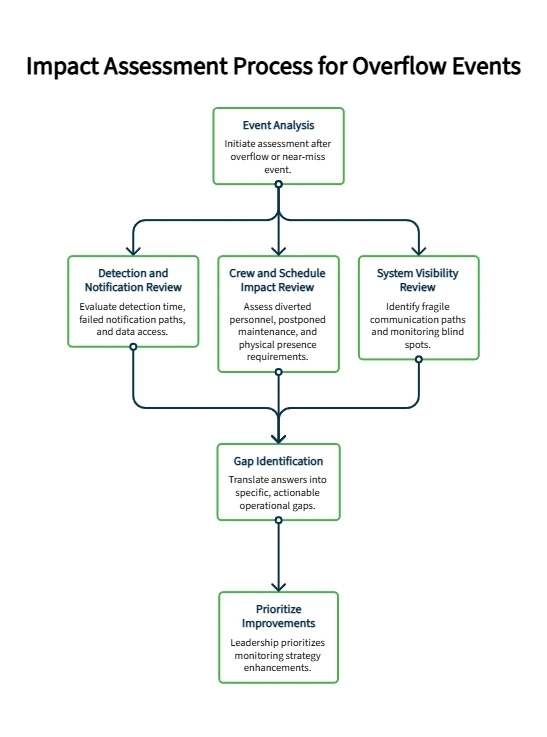
After any overflow event or near-miss, walking through the following questions systematically can help operations teams identify the specific gaps that need to be addressed. This worksheet is designed for practical use by superintendents and collection system managers — not as a financial calculator, but as a diagnostic tool for understanding where the operational drag is coming from. The first step is operational clarity: how much control was lost, which work was delayed, and which blind spot made the response harder.
Detection and Notification
How long was the overflow undetected, from the time the condition began to when the team was notified?
Which specific alarm, sensor, notification path, or callout step failed — or was never in place?
Did the team have access to alarm history, runtime trends, or remote status at the time of the event?
Crew and Schedule Impact
Which crew members were pulled away from their scheduled assignments to respond?
Which maintenance tasks were postponed as a result of the emergency, and when are they rescheduled?
Which part of the response depended entirely on someone being physically present at the station?
System Visibility
Which stations in the network still rely on aging or fragile communication paths?
Which stations have no remote visibility into pump status or wet well level during off-hours?
What is the first monitoring blind spot to address before the next high-inflow event or storm season?
Each answer points toward a specific, actionable gap. The goal is not to create a comprehensive audit in one sitting, but to give operations leadership a clear starting point for prioritizing improvements to the monitoring strategy.
Build an Overflow Prevention Plan Around Visibility, Redundancy, and Response
The next planning question is not "How much technology can be added?" It is "Where does the team still lack timely awareness?" The operational consequences of undetected overflows do not require a new budget category or a multi-year capital plan to begin addressing. They require an honest assessment of where the monitoring strategy has blind spots — and a prioritized approach to closing them.
Start with the stations that create the most operational anxiety. Review the alarm path. Confirm the callout list. Check whether crews can see useful alarm history and remote status. Then decide where redundancy, updated alerts, or better reporting would improve response control.
The fundamentals are straightforward: know what conditions are occurring at every active station, ensure that alerts reach the right people through a path that does not fail during storms or power events, and have enough historical data available to identify problems before they become emergencies. How to Build a Fail-Safe Wet Well Monitoring Strategy in 3 Steps provides a practical framework for working through exactly that process, station by station. For teams that already know which alarms need to be replaced or upgraded, Replacing Outdated Alarms: A Checklist for Lift Station Overflow Prevention offers a structured evaluation tool for assessing which systems are due for modernization. And for operations leaders who need to make the case internally for why reactive maintenance is not a sustainable long-term approach, The Danger of Reactive Maintenance: Why Traditional Wastewater Redundancy Planning Fails frames the systemic risk in operational terms that resonate with both field teams and municipal leadership.
The 3:00 AM call does not have to be the way overflows are discovered. A cloud based wastewater monitoring system with reliable cellular alerting, a backup battery, and historical data access changes what that moment looks like — from reactive crisis management to an informed, early response. That shift is the practical outcome that overflow prevention planning is designed to deliver.
If your team is evaluating specific monitoring options for lift stations currently operating with limited visibility, Get a Quick Quote or Contact Us to connect with a local OmniSite representative who can help assess the right fit for your system.
Disclaimer: This article is educational and is not legal, regulatory, environmental compliance, or engineering advice. Wastewater overflow response and reporting requirements vary by jurisdiction, permit terms, system design, and incident details. Municipal teams should verify requirements with qualified professionals and the appropriate regulatory authority.
Our Editorial Process:
Our expert team uses AI tools to help organize and structure our initial drafts. Every piece is then extensively rewritten, fact-checked, and enriched with first-hand insights and experiences by expert humans on our Insights Team to ensure accuracy and clarity.
About the OmniSite Insights Team
The OmniSite Insights Team translates municipal monitoring, wastewater operations, and infrastructure resilience topics into clear, practical guidance for utility leaders and operations teams. Its content is reviewed for clarity, source alignment, and usefulness before publication.